Murtala Mohammed’s Disobedience To “Order” Led To Asaba Massacre During Civil War
OpenLife Nigeria reports that 58 years after, former military head of state, General Yakubu Gowon, rtd, has offered a fresh account about the Asaba massacre during the civil war which occurred on October 5-7 1967 in Asaba.
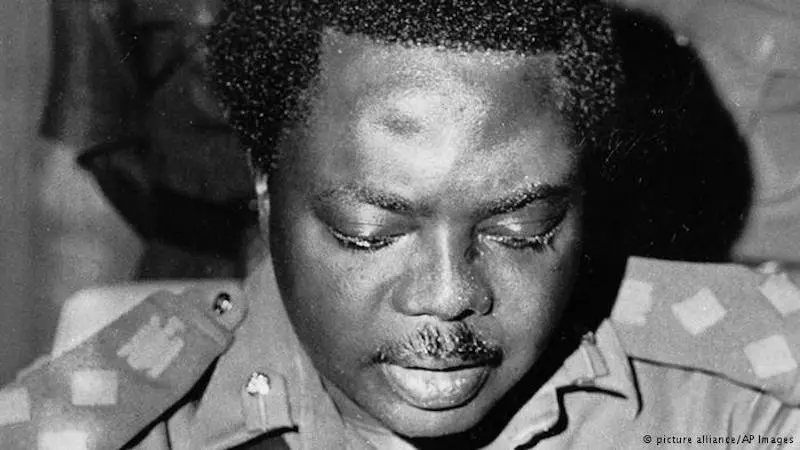
The massacre was a deadly onslaught perpetrated by the Nigerian Army, specifically the Second Infantry Division under the command of Murtala Muhammed which targeted the people of Asaba, mostly Igbo people.
Background To The Massacre
In August 1967, three months into the Biafran War, Biafran troops invaded the Mid-Western Region, to the west of the River Niger.
They spread west, taking Benin City and reaching as far as Ore, where they were pushed back by the Nigerian Second Division, under the command of Col. Murtala Muhammed.
The Federal troops gained the upper hand, and forced the Biafrans back to the Niger, where they crossed the bridge back into the Biafran city of Onitsha, which lies directly across from Asaba.
The Biafrans blew up the eastern spans of the Onitsha bridge, so that the Federal troops were unable to pursue them.
Angry over the blew up of the Onitsha bridge by the Biafran soldiers, the Federal troops entered Asaba around October 5, and began ransacking houses and killing civilians, claiming they were Biafran sympathisers.
According to reports, several hundred innocent males may have been killed individually and in groups at various locations in the town.
At a point, leaders of the community summoned the townspeople to assemble on the morning of October 7, hoping to end the violence through a show of support for “One Nigeria.”
Hundreds of men, women, and children, many wearing the ceremonial akwa ocha (white) attire paraded along the main street, singing, dancing, and chanting “One Nigeria.”
At a junction, men and teenage boys were separated from women and young children, and gathered in an open square at Ogbe-Osowa village.
At that point, federal troops were said to have brought out machine guns, and orders were given, reportedly by Second-in-Command, Major Ibrahim Taiwo, to open fire, killing many till 7 October.
The bodies of some victims were retrieved by family members and buried at home. But most were buried in mass graves, without appropriate ceremony. Many extended families lost dozens of men and boys.
Federal troops occupied Asaba for many months, during which time most of the town was destroyed, many women and girls were raped or forcibly “married,” and large numbers of citizens fled, often not returning until the war ended in 1970.
Fresh revelations, contained in Gowon’s autobiography, ‘My Life of Duty & Allegiance’, have offered rare personal insights into the rivalries, battlefield mistakes and political tensions that shaped the 1967–1970 civil war.
The former Head of State has reopened some of the deepest controversies of Nigeria’s Civil War, revealing how the late sage, Chief Olusegun Awolowo stepped in to save late military ruler, Gen. Murtala Mohammed.
Gowon revealed one of the sharpest revelations in the memoir which concerns the failed federal attempt to cross the River Niger from Asaba into Onitsha, an operation long regarded as one of the war’s most controversial military decisions.
Gowon said Murtala ignored repeated warnings against the operation because of rivalry with another commander and his determination to claim battlefield glory.
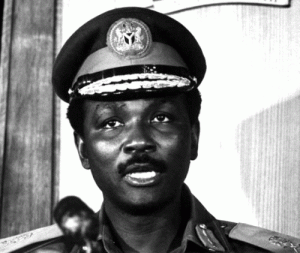
“As the C-in-C, I considered his plan quite suicidal,” Gowon wrote.
According to him, Army Headquarters warned that rebel forces could destroy the Onitsha Bridge and trap federal troops during the crossing.
Gowon said he advised Murtala to approach Onitsha through alternative land routes already secured by federal forces, but the commander refused.
“His pride did not allow him to wish to pass through 1 Division area owing to his rivalry with Colonel Shuwa,” he stated.
The former Head of State said the operation ended in disaster after Murtala pressed ahead with the river crossing.
“Murtala did not accept my advice and did exactly as he had proposed, to cross the River Niger by boats and barges, but with catastrophic consequences of the loss of men and equipment during the failed river crossing,” he wrote.
Signal That Nearly Cost Murtala His Command
The war also exposed deep fractures inside the federal command.
Gowon recounted how Murtala once sent him what he described as an insulting signal from the battlefield during intense fighting.
“In a fit of anger, he went beyond the bounds of reason or military decorum to send me, his Commander-in-Chief, an impertinent signal that I should get my fat butt off my chair to sort out things in the battlefield instead of giving orders from the comfort of my office in Dodan Barracks,” Gowon wrote.
The former wartime leader said the message angered him so much that he considered removing Murtala from command immediately.
“His unconscionably rude signal to me from the war front made me angry enough to consider removing him from command with immediate effect,” he stated.
But Gowon said Awolowo stepped in before he acted. “Chief Awolowo noticed the depth of my anger with Murtala after I received the signal. He promptly intervened on his behalf and pleaded that I should not respond the way I had intended,” he recalled.
About Author