Failed Governance In Kwara State
OpenLife Nigeria reports that Kwara State has been in the eye of the storm lately over incessant attacks on residents by unrelenting bandits and kidnappers, particularly in the northern and southern parts of the state, despite the spirited efforts of the government to combat insecurity.
Among the 16 local governments in the state, the five local governments, otherwise called emirate councils, namely Ilorin East, Ilorin West, Ilorin South, Asa, and Moro, have not been seriously affected by the ongoing insecurity.
The same with Offa and Oyun local governments, leaving the remaining nine local governments scattered in the southern and northern parts of the state under siege of killings and abductions by the bandits.
It is gathered that the bandits, comprising mostly herdsmen from Zamfara and Sokoto states who infiltrated Kwara through Niger State, in connivance with some locals, have been perpetrating the current criminalities in the state for some time now.
It was also gathered that they operate in the thick forest in the northern and southern parts of the state where they have settled for close to 30 years now.
Sources said these people residing in the thick forests, in connivance with some locals who provide information, reportedly embraced the business of kidnapping some years back having realized that it is a much easier means of making quick and big money, turning them overnight into billionaires.
Reported cases of abductions and killings started in local governments in the northern part of the state, namely Edu, Patigi, Baruten, and Kaiama, about four years ago before it became a regular occurrence.
In Kpanpkanragi village in Edu Local Government, among several other attacks, armed bandits abducted a woman in a late-night assault in August.
About the same time in Gamalegi village in the same local government, four people were abducted by gunmen.
As if these weren’t enough, bandits launched a second brutal attack on Lataworo community in Edu LGA, forcing residents to flee.
Also, a prominent businessman was abducted in Tsaragi, in Edu.
In another attack, bandits killed a newlywed and stole hundreds of cows in Bokungi, Tsaragi community in the LGA.
There were also unreported cases of the killing of farmers on their farms and abductions in Kaiama Local Government.
Similarly in August, six people were kidnapped in Motokun and Agboro communities in Patigi Local Government while six others suffered gunshot wounds during an operation.
In Kwara South, being the immediate neighbors of Kwara North, in September in Babanla community in Ifelodun Local Government, two people were abducted shortly after Governor AbdulRahman AbdulRazaq visited.
It was gathered that more than 90% of the families and relations of the abductees since the crisis of insecurity started have been put under financial pressure by raising hundreds of millions of Naira demanded by kidnappers, a development that made kidnappings unstoppable in the state.
“No sane person would fold his arms when kidnappers demand ransom to free their loved ones. Today, aside the millions they demand, they have added drinks, foods, etc to their list”, Emmanuel Ayeoribe, a former Chairman of the Nigeria Labour Congress (NLC) in Kwara State, who contributed money towards releasing an abducted friend, told Sunday Vanguard.
“Many businesses and lives have been ruined financially in the process of securing family and friends from the jaws of bandits.
“This is very unfortunate in a country where we have governments that have powers to do and undo. It is their responsibility to protect lives and properties of citizens, so the ball is their court.”
Actions
But the state government hasn’t folded its arms as several actions were being taken to stop the menace.
For instance, Governor AbdulRazaq supported security agencies with logistics like vehicles and motorcycles to fight these criminals.
With the bandits unrelenting in their actions, he has, however, called for increased military presence.
In the meantime, the police, the military, and local vigilantes have been involved in joint searches for attackers and rescued some abducted victims, while several others are still left with kidnappers.
But since government was not winning the battle anytime soon, or so it seems, it took key decisions to mitigate the impact among which were the forced closure of cattle markets in Kwara South and relocation of the NYSC Orientation Camp from Yikpata in Edu Local Government to Ilorin, the state capital.
In the same vein, the 2025 Medical and Surgical Outreach in Ifelodun was relocated from Oke-Ode to Omupo following the Oke-Ode attack.
It would be recalled that despite government’s efforts, bandits have persisted in attacking Oke-Ode, Ndanaku, and Lataworo, leading to deaths, abductions, and displacement.
The latest attack was the massacre last Sunday morning in Oke-Ode where no fewer than 11 forest guards and a community head were killed by suspected bandits.
The suspected bandits allegedly took advantage of the Department of State Service (DSS) withdrawal of ammunition from the forest guards to launch the fatal attack, a claim that government disputed.
While the attack lasted, an unspecified number of residents were also reportedly kidnapped.
A member of the forest guards, who escaped the attack and simply identified as Ajetunmobi, said that government was engaging in propaganda over the incident.
“We have been hearing that the bandits were around the community since Saturday night and we sent out messages to security operatives to be prepared”, he narrated.
“But to our surprise, this morning, the attackers started the attack from the duty post, targeting vigilantes”.
According to him, among those killed were community members identified as Oji, Saheed Metubi and Baale Ógba Ayo, among others.
He said the corpses of the victims had been taken to the police station in the area while the injured were rushed to the General Hospital in Share.
The survivor particularly accused government of failing in its primary duty of protecting citizens, noting that intelligence about a possible attack had circulated days earlier.
“The government failed in its primary duty. Information had been circulating for some time now that they were planning to attack Oke-Ode. Why were the soldiers withdrawn?” he asked.
Viral video
In a viral video that trailed the attack, a lady, who appeared distressed, was seen mourning her dead husband and his brother.
She also accused the DSS of disarming the town’s vigilantes prior to the attack, a move she claimed gave the assailants undue firepower advantage.
But the state government, in a response, dismissed the claims that the DSS disarmed the vigilantes otherwise known as forest guards in Oke-Ode.
The state government, in a statement by the governor’s Chief Press Secretary, Rafiu Ajakaiye, described the claim as false, saying that at no time did the DSS disarm vigilantes in any part of the state.
The statement on Tuesday came on a day security forces reportedly eliminated several terrorists on the border between Kwara and Kogi states by air strikes.
According to top security sources, notable among those killed was a kidnap kingpin called Maiwada and several foot soldiers of his.
Kwara State government ”expressed strong reservations about the “demoralising, albeit false, claim” which was made in the viral video by the woman who said DSS disarmed the vigilantes otherwise known as forest guards in Oke-Ode.
“We pray to God to console the bereaved woman — and every other one — but her claim is not true,” noted the Ajakaiye statement, quickly adding, “this clarification does not in any way de-legitimise her grief.”
Security measures
For his part, the National President of the Oke-Ode Community Development Association, Alhaji Ganiyu Ajala, while condemning the Oke-Ode killings, urged the state government to intensify security measures.
Security forces are also fighting back as a Nigerian Air Force fighter jet reportedly commenced operation Monday evening in the thick forest hideout of bandits located in the area, especially on the outskirts of Babasango, neighboring Kogi State, and left scores of them dead.
The Director of Public Relations and Information of NAF, Ehimen Ejodame, confirmed the development in a statement made available to journalists in Ilorin Tuesday afternoon.
“NAF conducted multiple coordinated missions across Kakihun, Oke-Ode, Babanla and surrounding areas”, he said.
“Reconnaissance and close air support operations were executed to deter threats, while hostile elements sighted east of Babanla were decisively engaged.
“Concurrent surveillance flights also covered key settlements and military positions, gathering critical intelligence to support ground forces.”
Training
In a related development, Sunday Vanguard gathered that about 800 vigilantes were trained at the military barracks in Sobi, Ilorin on security tactics and how to handle guns, in complementing efforts of the military and other attached security agencies in dealing with the criminals causing terror in the state of harmony.
Sources said the challenge of the forest guards recruited by the state is their inability to access AK-47 rifles which the bandits and the kidnappers are reportedly using to overpower them.
Furthermore, it was learnt that the bureaucracy of getting the military and officers of NAF to quickly come to the rescue of the state government at the nick of time had been a major challenge to the state government, causing a lull in the speed with which it wanted to eliminate the bandits from the state.
It was further gathered that, despite the available information provided by the forest guards about the locations of the bandits in the thick forest, efforts by the state government to get the actionable support of the Air Force and military in neutralising the bandits are being sabotaged as they’re not always forthcoming.
“This therefore makes it easy for the bandits with superior weapons and information from the local saboteurs to overrun the forest guards and even the police officers at strategic times”, a local in Oke-Ode who pleaded not to be named said.
A security expert, who also craved anonymity, said in an interview that the recent security lopsidedness in Nigeria whereby the police, army, and even Air Force are not under the state government, but federal, at times like this make all the actionable efforts of the state government to effectively fight criminalities a nullity.
Governor AbdulRazaq, after a security meeting on Tuesday in Ilorin, vowed that he will fight insecurity with every resource at his disposal, assuring that Kwara will not be a hiding place for criminals.
History
Created on May 27, 1967, when the Federal Military Government of General Yakubu Gowon broke the four regions that then constituted the Federation of Nigeria into 12 states, Kwara State is a state in Western Nigeria, bordered to the east by Kogi State, to the north by Niger State, and to the south by Ekiti, Osun, and Oyo states, while its western border makes up part of the international border with Benin. Its capital is the city of Ilorin and the state has 16 local government areas.
Before its creation, the state was made up of the former Ilorin and Kabba provinces of the then Northern Region and was initially named the West Central State but later changed to “Kwara”, a local name for the River Niger, in the Hausa language.
Kwara state has since 1976 reduced considerably in size due to further state creation exercises in Nigeria. On 13 February 1976, the Idah/Dekina part of the state was carved out and merged with a part of the then Benue/Plateau state, to form Benue state.
On 27 August 1991, five Local Government areas, namely Oyi, Yagba, Okene, Okehi and Kogi were also excised to form part of the new Kogi state, while a sixth, Borgu Local Government Area, was merged with Niger state. The major populated local governments are Ilorin and Offa.
Kwara state has numerous mineral resources such as tourmaline, tantalite, and many mineral deposits in the northern part. Cocoa and Kolanut in the Southern parts Oke – Ero, Ekiti and Isin LGA.
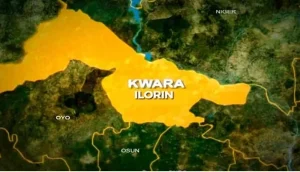
Of the 36 states of Nigeria, Kwara is the ninth largest in area but the sixth least populous with an estimated population of about 5.2 million. Geographically, Kwara is split between the West Sudanian savanna in the east and the Guinean forest–savanna mosaic ecoregion in the rest of the state. Important geographic features include rivers with the Niger flowing along the northern border into Lake Jeba before continuing as the border while the Awun, Asa, Aluko, and Oyun rivers flow through the interior.
In the far northwest of the state is the Borgu section of the Kainji National Park, a large national park that contains populations of grey heron, kob, hippopotamus, African bush elephant, olive baboon, and roan antelope, along with some of the last remaining West African lions on earth.
In the far southwest, a small part of the Old Oyo National Park contains crowned eagle, martial eagle, African buffalo, oribi, and patas monkey populations.
Kwara State has been inhabited for ages by various ethnic groups, primarily the majority Yoruba people that live throughout the state. There are also sizable minorities of Nupe people in the northeast, Bariba (Baatonu) and Busa (Bokobaru) peoples in the west, and Fulani people in Ilorin and moving through the state as nomadic herders.
In the pre-colonial period, the majority of the area that is now Kwara state was part of the Oyo Empire, with part of the western portions in the Borgu Kingdoms peopled by the Bariba, Boko and Bissa people, and Nupe Kingdom (1531–1835). In the mid-1800s, the Fulani jihad annexed some part of what is now the state of Kwara and placed the area under the Gwandu sphere of the Sokoto Caliphate. In the 1890s and 1900s, British expeditions occupied the area and incorporated it into the Northern Nigeria Protectorate.
The Northern Nigeria Protectorate later merged into British Nigeria in 1914, before becoming part of independent Nigeria in 1960. Originally, the modern-day Kwara state was a part of the post-independence Northern Region until 1967, when the region was split and the area became the West Central State. In 1976, the state was renamed Kwara State and the name remained until the 1990s when its southeast was split off to form a part of Kogi state and its far northwest Borgu division was annexed into the Borgu division of Niger state.
Economically, Kwara state is largely based around agriculture, mainly of coffee, cotton, groundnut, cocoa, oil palm, and kola nut crops. Other key industries are services, especially in the city of Ilorin, and the livestock herding and ranching of cattle, goats, and sheep. Kwara state has the joint-twentieth highest Human Development Index in the country and numerous institutions of tertiary education.
Languages of Kwara State listed by LGA:
About Author