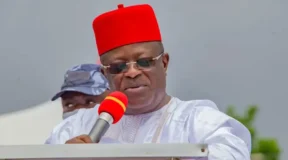
Tompolo
OpenLife News reports that the rise of High Chief Government Ekpemupolo, popularly known as Tompolo, from Niger Delta militant commander to one of Nigeria’s most influential political financiers has reopened uncomfortable questions about wealth, power and fiscal responsibility under President Bola Tinubu.
At the centre of the debate is a simple triangulation: a multi-billion naira pipeline surveillance contract funded by a state-owned company, a nationwide political campaign structure bankrolled by the contractor, and a lack of public audit of either.
Source of wealth: The Tantita pipeline economy
Tompolo’s known business vehicle is Tantita Security Services Nigeria Limited.
In August 2022, under President Muhammadu Buhari, Tantita was awarded a pipeline surveillance contract to curb crude oil theft, widely reported at N4 billion monthly or about N48 billion annually.
The contract was renewed and expanded under the Tinubu administration, with some reports valuing associated coastal security deals at around $144 million.
More sensational figures have since emerged.
Former militant, Asari Dokubo, has claimed in a viral video that pipeline contracts linked to Tompolo and others run into N2.7 trillion annually.
But neither Dokubo nor independent analysts provided contract documents or NNPCL payment records to back the claim, and the figure has been challenged by the Olu of Warri’s representatives.
Beyond Tantita, Tompolo has interests in maritime services, dredging and real estate in Delta State, but no independently audited net-worth exists. His wealth, publicly, is contract-driven.
Political benevolence: The PBAT Door-to-Door machine
Since late 2024, Tompolo has emerged as grand patron and founder of the PBAT Door-to-Door Movement, the most visible grassroots vehicle for Tinubu’s 2027 re-election.
The pattern is consistent across states.
In Kogi, he donated 25 campaign vehicles, prompting Governor Ahmed Ododo to publicly describe Tompolo as “my mentor, my leader, benefactor… gave me very massive support” during his 2023 governorship campaign.
In Kano, 50 vehicles; in Oyo, 32 vehicles to mobilise for Tinubu and APC candidates, and similar batches in Yobe, Taraba, Bauchi and others.
Represented at events by Tantita MD Kestin Pondi, Tompolo’s message is uniform: “President Bola Tinubu’s policies have been wonderful. They have helped our governors to have more money for projects” and therefore need consolidation beyond 2027.
The strategy is national, not regional.
By financing campaign logistics outside his South-South base, Tompolo is positioning himself as a pan-Nigerian political enabler, with a pitch to the North to support Tinubu’s second term so power can return to the North in 2031.
The fiscal responsibility hole
This is where the questions get sharp.
Value for money
Critics argue that paying N48 billion a year to private actors to secure pipelines that are a sovereign asset raises questions about the capacity of the Navy and NSCDC, and about measurable outcomes in crude production. If oil theft falls, Tantita claims credit; if it rises, it blames sabotage.
Public money for partisan politics?
The Allied People’s Movement (APM) has accused the Tinubu administration of “diverting government funds through its contractor on oil pipeline surveillance, Government Ekpemukpolo Tompolo to fund the 2027 general elections.”
Its publicity secretary, Abubakar Yusuf, said the distribution of 50 buses in 36 states and FCT “is a diversion of government funds at the expense of providing good roads, infrastructural development, payment to local contractors.”
The allegation remains unproven. No EFCC, ICPC or NNPCL audit has been published to trace Tantita payments to campaign spending.
But the opacity itself is the problem. NNPCL, as a limited liability company post-PIA, does not publish detailed contract performance reports, and INEC does not currently audit the source of funds for support groups like PBAT Door-to-Door.
Perception of rewarding criminality
Security analyst Zik Gbemre warned that “if individuals previously linked to pipeline sabotage are rewarded… it risks creating perception that crime eventually pays.”
Public outcry and expectations
In a chat with OpenLife, a Professor of Delta State University who did not want his name mentioned, expressed concerns over the public display of fiscal irresponsibility.
While the Professor was not particularly against striving private security business, he however requested that for Tompolo’s political philanthropy to be fiscally responsible, three disclosures are needed.
NNPCL should publish the full value, tenure and KPIs of Tantita’s contract
Tantita should file separate accounts for its security business and political donations
INEC should require support groups donating hundreds of vehicles to declare funding sources under the Electoral Act.
Until then, Tompolo, in the views of the Professor, remains both an asset to Tinubu’s re-election — delivering vehicles, mobilisers and Niger Delta stability — and a liability to the narrative of fiscal discipline that the administration claims its reforms represent.
N10 billion to the Delta State Security Trust Fund
On Wednesday, October 15, 2025, at the Delta State Security Trust Fund which held at Banquet Hall, Government House, Asaba, Tompolo was unveiled as Chief Launcher of the Fund.
On his behalf, the Managing Director, Chief Keston Pondi announced a N10 billion donation.
The event, chaired by Access Holdings Chairman Aigboje Aig-Imoukhuede, was convened by Governor Sheriff Oborevwori to reactivate the Security Trust Fund Law originally enacted in 2013.
Speaking through Pondi, Tompolo said the contribution was not just philanthropy but “a strategic investment in peace, progress, and the protection of lives and property,” pledging Tantita’s full backing for the state’s security architecture.
The Fund has been designed as a public-private partnership to mobilize private sector resources to complement government spending on modern surveillance equipment, patrol vehicles, communication gadgets, and training of security personnel and vigilantes across Delta’s 25 LGAs.
His supporters hailed it as patriotic and a model of corporate social responsibility, while critics online pointed to the irony of a former MEND commander turned NNPCL pipeline contractor now funding state security, with monthly surveillance deals reportedly worth billions.
Who is Tompolo?
According to Wikipedia, Government Oweizide Thomas Ekpemupolo aka Tompolo was born on April 12, 1971 at Okerenkoko, Gbaramatu Kingdom, Warri South West Local Government Area , Delta State, Nigeria.
An Ijaw tribe, he was born by Chief Thomas Osen Ekpemupolo and Mrs Sologha Ekpemupolo of Okerenkoko Royal Family, Gbaramatu Kingdom.
The name, Tompolo, a nickname derived from his father’s name Thomas shortened to Tom and Ekpemupolo.
He is the 5th child and only male child among 8 children of his mother. His father was polygamous with 5 wives.
His name Oweizide means “I have given birth to a man” in Izon language; Government was prophetic name given by father.
He attended Okepopo Primary School, Warri. Other accounts mention he also started at Ogeh Primary School, Kunukunuma, Gbaramatu, Edah Primary School Madagho, and Kunpa Primary School Kunukunuma before Okepopo.
He learned to speak Itsekiri while in Warri primary school.
Information has it that Tompolo attended National Comprehensive College, Warri, and completed SSCE in 1993.
He did not proceed to university immediately. After secondary school, he became Manager of his father’s company Tompolo Nigeria Limited, an oil servicing sub-contractor dealing in boreholes, concrete jetties, diesel supply.
Around 1993, he was said to have joined Niger Delta resistance group and began quasi-military career during Warri crisis over relocation of Warri South West HQ from Ogbe-Ijoh to Ogidigben.
He subsequently joined Ijaw Youth Council and rose to become the group leader.
In early 2000s and as leader of Federated Niger Delta Ijaw Communities (FNDIC) they allegedly shut 40% of Nigeria’s oil via attacks mainly on Chevron.
Thereafter, he founded Camp 5 in Okerenkoko, operational HQ, and High Commander of Movement for Emancipation of Niger Delta (MEND).
On October 4, 2009, the group embraced Presidential Amnesty under Yar’Adua.
He founded Tantita Security Services Limited, a pipeline surveillance contractor In religion, he is known as a Chief Priest of Egbesu Deity, god of war and justice in Ijaw religion; leader of Woyin.
He is married with children, resides in Delta State.
Aside business, his current engagement includes being Grand Patron PBAT Door-to-Door Movement for Tinubu 2027.
About Author