The Problems With Governors Adeleke And Fubara
OpenLife Nigeria reports that arising from the crises bedeviling the Peoples Democratic Party, PDP, Nigeria’s main opposition party, Mr. Ini Ememobong, the National Publicity Secretary of the party appeared on Channels Television Thursday, December 11, 2025, to clarify vague issues
First things first, if you described Governor Fubara’s defection as a “self-inflicted injury,” how would you describe Governor Adeleke’s defection?
Well, Governor Adeleke’s defection… he’s a victim of circumstance, which is vicarious. Vicarious because every problem has a human cause and therefore should also have a human solution.
At the level of the leadership which he belonged to at the party, the party ought to have acted decisively.
Is it a challenge? Immediately we begin to feed the monster without knowing that we’ll end up in the belly of the monster. After a while, we become victims. So if we feed animals to the monster, we feed others to the monster, and we think that time would solve problems… Time allows human beings to solve problems; it doesn’t on its own solve problems.
So it’s vicarious in the sense that strong action by leadership ought to have been taken from 2023 immediately the decline started. But there were negotiations. I mean, you also cannot fully blame them because sometimes you think that with negotiations, when passions are calm, people could reconsider their position.
But unfortunately, it didn’t, until the convention took the decision it did in Ibadan. So that’s the nature of what has happened. He’s become a victim of circumstances arising from vicarious liabilities which he cannot completely extricate himself from.
So, you sort of give excuses for Governor Adeleke, but for Governor Fubara of Rivers State, no excuse at all? What is really different? Because he could well say, “In fact, if there’s anybody that has been a victim of circumstance, it is me.” So what exactly is at play here? Why do you give an excuse for one and the other you slam?
No, we’re not giving excuses. We’re saying that both are circumstantial, and even the victims of the circumstances themselves had a role to play in the conflict that eventually engulfed them. So we’re not making excuses.
But in the case of Fubara, you do know that Fubara voluntarily became a candidate of the party. And you do know that the people who brought him have always said that there were agreements. We’re talking about agreement… till today he hasn’t said what the agreement was, but his political party stood by him.
The point of our anger is really when he mentioned that he wasn’t secure in the platform. We all have great sympathies for Fubara even as a person.
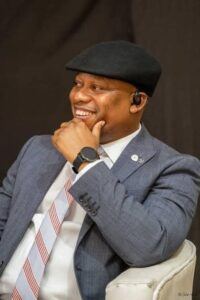
Before becoming a Publicity Secretary, I had sympathies for him—a calm, gentle person who is pushed to the wall, who has no other direction to move than in the opposite direction. But to attempt to lay blame other than where blame ought to be… Because if you backtrack and look at the origin of the crisis, you know that the origin is between two people.
You remember that people rose up at the beginning of this crisis and began to speak for him. After a while, he came out and said, “No, no, don’t worry, it’s a father-son matter.” And after a while, a state of emergency was declared. People started advocating, and he went silent.
I spoke to some governors, especially Governor Bala, asking what happened. Governor Bala said, “Look, we were ready and we have deployed at some points, but the governor would either remain incommunicado or will say ‘don’t worry, we would handle it’.” So, volenti non fit injuria—you cannot do harm to a consenting person.
So while he has our sympathies, the attempt to shift blame is what we are very angry with. There’s no need shifting the blame. When you get into a voluntary agreement… till today he has not said what agreement he got into. He has not really told Rivers people or us on camera or confided in anyone what the real issues are.
So while we sympathize with him—and we know that this is a situation where Stockholm syndrome has happened, where a captive has fallen in love with the captor—we frown against that conscious amnesia where he picks and chooses where the blame should be. He knows where the origin of his problem is.
So many questions emerge from your defense of your party, particularly in the Fubara case. Would it be the first time that a predecessor would be having an agreement with a successor governor? And would the party have been diligent to call out a governor at all if the agreement was just going smooth sailing without things turning awry? I’d like you to respond to that first.
You do know that people do not enter a crisis until the parties themselves have declared war. So if people have agreements and the agreement is going fine and the state is not suffering, you have no business going into it because you wouldn’t even know there was an agreement.
But it is when people begin to shout or things begin to happen to suggest that a crisis has occurred, that’s when third parties come in.
In this circumstance, even when he went to the meeting with the President, did he consult the party? Did he consult the Governors’ Forum? Remember that even after his election as governor, it took a long while for him to even associate with the party. We quite understand that maybe his hands were tied. But immediately you feel the pinch, you begin to call for help.
Are you saying that agreements do not exist between governors/predecessors and their successors?
I’m not saying that agreements do not exist, but the first thing is that there cannot be a valid agreement to commit a crime. If the agreements are to siphon state funds or lead the state in a way inconsistent with the constitution, that’s an illegal agreement. But if people have political agreements—”this one will take this, this one will take that”—those are not illegal. But where agreement fails, and understanding fails, then if the parties begin to speak out, the third parties will come in.
Well, it just looks like abandonment because the governor has left the party and hence the PDP is now calling him out. Talk to us about why the PDP governors did not go all the way with the court case initiated to challenge the state of emergency and suspension of democratic institutions by the President in Rivers State? Which is probably what Governor Fubara is citing as the party abandoning him when he needed it most.
No, that’s not true. You do know that even at the last NBA conference, very senior lawyers raised the issue that there was a court case and the Supreme Court did not fix the hearing… But number two, when you are fighting for a person, you must fight in the interest of the person. And the person in whose interest you are fighting must feel that you are fighting in his interest.
If you look at the disposition of the governor, even in that whole period, he discouraged people from fighting. Commentators coming out from Rivers State to attempt to fight… what was his disposition? “He will sort the matter out.” You cannot cry more than the bereaved at a funeral.
The PDP governors took steps, but the steps you’re taking must have the person’s go-ahead. You don’t file a case in court and someone comes to say, “I didn’t send you to do that.” We have been having discordant dispositions from the governor. When he was ready to fight, everyone fought along with him—look at the local government election, he had all the support.
But in a circumstance where you are not fighting from the front and you’re asking people to backtrack, then people begin to think maybe fighting further would hurt your interest. It’s like a patient who tells you, “If you give me injection, I will die.” You cannot still go ahead and give that patient injection against his own will.
That’s a very interesting analogy. But because of time, let’s talk about where the PDP is currently now. Two groups pulling apart… you have five governors on paper but less than that at heart left in the party. As a party, do you agree that the PDP has failed?
To fail would mean that an examination has been set. When you look at the ruling party, despite having a President… look at what happened in Osun, the President had to intervene. A political party looks homogeneous from the outside, but inside it is a potpourri of heterogeneous struggles for power. The political party is the hotbed for conflict, which is why the most critical leadership tool is conflict resolution.
At this rate, by 2027… there are two governors that are suspect right now. Are you begging them to stay or can they do what they want?
No. In the circumstance that we are, you know that except for the legislature where the law binds their hands, every executive has the capacity to do what is… it would be legal but immoral. So we are not begging anybody, but we are reaching out. The Turaki led administration is reaching out, the Governors’ Forum is reaching out. But you know there’s a thin line between what is illegal and what is immoral.
Because of time, I just wanted to understand what you are doing to try to keep those governors. We wish the PDP the very best.
Thank you very much.
About Author