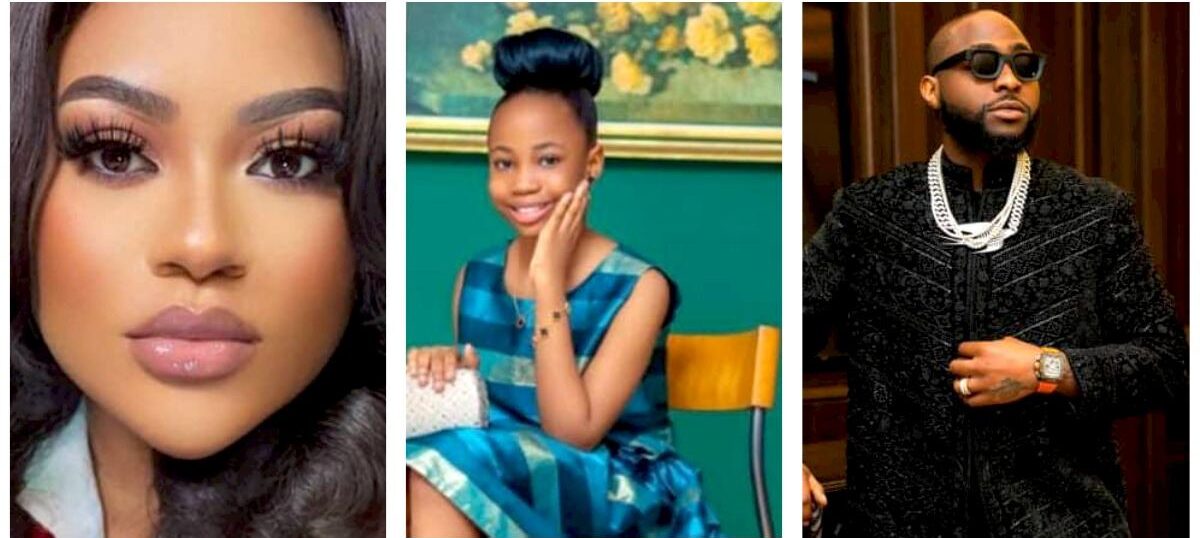
Nkechi
OpenLife Nigeria reports that the ongoing public controversy involving Afrobeats superstar Davido and the family of Anuoluwapo, the young woman whose pregnancy became the center of a bitter paternity dispute, has taken another dramatic turn. This time, the spotlight has shifted to Nollywood actress Nkechi Blessing, whose blunt and indirect remarks on social media have ignited intense reactions across Nigeria’s digital space.
Fueling the renewed debate is a blunt and indirect statement made by Nollywood actress Nkechi Blessing, which many Nigerians immediately linked to the ongoing saga. Without mentioning any names, the actress shared a strongly worded message directed at women, one that quickly went viral and divided public opinion.
She wrote:
“Ladies, hopping on different D’s is not the best way to live life… Make you no go forget who give you belle, come dey find where to hang am put… Rubbish.”
Though framed as general advice, the timing and tone of the post led many social media users to interpret it as a clear reaction to the Davido and Anuoluwapo paternity dispute. Within hours, screenshots of the statement flooded blogs and comment sections, reigniting arguments that had barely cooled.
BACKGROUND OF THE DAVIDO AND ANUOLUWAPO PATERNITY DISPUTE
The controversy traces
back to claims made by Anuoluwapo’s family, who publicly alleged that Davido was responsible for her pregnancy and, by extension, the child she carried. According to the family, the singer had a relationship with Anuoluwapo and should accept responsibility as the biological father of the child.
Given Davido’s status as one of Africa’s most influential music stars, the allegation immediately attracted massive public attention. Fans, critics, bloggers, and commentators dissected every detail, with emotions running high on all sides.
Davido and his family responded by firmly denying the allegations. They stated that DNA tests were conducted after the child’s birth and that the results conclusively showed that Davido was not the biological father.
This position was repeatedly emphasized by members of his camp, who maintained that scientific evidence had cleared him of any responsibility.
Despite these claims, the dispute did not fade away. Instead, it lingered in the public domain, fueled by emotional narratives, online speculation, and a lack of publicly released documentation.
As a result, the issue remained unresolved in the eyes of many Nigerians, continuing to provoke debate long after initial statements were made.
SOCIAL MEDIA AND THE ESCALATION OF A PRIVATE MATTER
Social media platforms played a critical role in transforming the dispute from a private issue into a national spectacle. Posts, videos, voice notes, and opinion threads spread rapidly, often blurring the line between verified information and personal interpretation.
Supporters of Davido emphasized the importance of DNA evidence and warned against the dangers of false paternity claims, particularly when directed at public figures.
On the other hand, sympathizers with Anuoluwapo and her family focused on the emotional weight of the situation, arguing that the matter involved vulnerability, trust, and personal loss.
In this charged environment, even indirect commentary from celebrities became magnified. Every post was scrutinized, every word analyzed, and every silence interpreted as a stance. It was within this context that Nkechi Blessing’s statement landed, making it almost inevitable that it would be linked to the ongoing controversy.
NKECHI BLESSING’S WORDS AND THEIR PERCEIVED MESSAGE
Nkechi Blessing’s post stood out because of its bluntness and lack of ambiguity in tone. While she did not reference specific individuals, the language she used was sharp and accusatory, focusing on sexual responsibility and the consequences of personal choices.
Many readers immediately perceived her words as condemning what she believed to be false paternity claims. The phrase “come dey find where to hang am put” was widely interpreted as a criticism of women allegedly attempting to assign pregnancy responsibility to the wrong man.
For supporters of Davido, the actress’s statement felt like validation. They saw it as a rare moment where a public figure openly addressed what they believed to be an uncomfortable truth—that men can also be victims of false accusations, and that accountability must apply to everyone.
PUBLIC REACTION: PRAISE AND BACKLASH
The response to Nkechi Blessing’s statement was swift and deeply divided. On one side were those who applauded her for speaking boldly about personal responsibility.
These supporters argued that society often avoids difficult conversations about sexual accountability, particularly when women are involved, and praised the actress for addressing the issue without fear of backlash.
Some social media users described her post as
“hard truth,” insisting that emotional narratives should not override facts such as DNA evidence. Others praised her courage, noting that many celebrities prefer to remain silent on controversial issues to protect their image.
However, the backlash was equally intense. Critics accused Nkechi Blessing of lacking empathy and sensitivity, especially given the emotional nature of the dispute.
They argued that her words reduced a complex situation to a moral lecture, ignoring the pain and confusion that often accompany such cases.
Several users also criticized the generalization in her statement, suggesting that it unfairly stigmatized women and reinforced harmful stereotypes about female sexuality.
ABOUT NKECHI BLESSING?
Nkechi Blessing Sunday is a well-known Nigerian actress, filmmaker, entrepreneur, and social media personality. She gained prominence in Nollywood through her roles in both Yoruba and English-language films, where she often portrays strong, outspoken characters.
Beyond acting, Nkechi Blessing is known for her unapologetic presence online. She frequently shares personal opinions on relationships, societal norms, gender roles, and life experiences. Her candid nature has made her one of the most talked-about actresses on Nigerian social media.
While her outspokenness has earned her a loyal fan base that admires her honesty, it has also attracted criticism from those who view her approach as confrontational or controversial. Regardless of public opinion, she remains a significant voice in entertainment discourse.
CELEBRITY OPINIONS AND THEIR INFLUENCE ON PUBLIC DISCOURSE
The controversy surrounding Nkechi Blessing’s statement highlights the broader issue of celebrity involvement in sensitive personal matters.
In today’s digital age, celebrities are no longer just entertainers; they are influencers whose opinions can shape public narratives.
When public figures comment on unresolved disputes, their words can validate certain perspectives while marginalizing others. This influence comes with responsibility, particularly when the subject matter involves allegations, family disputes, and emotional trauma.
In the Davido case, celebrity commentary has often intensified polarization rather than encouraged resolution, demonstrating how powerful and potentially harmful public opinions can be.
PATERNITY DISPUTES IN THE MODERN AGE
Beyond the personalities involved, the Davido–Anuoluwapo controversy reflects a larger societal challenge: how paternity disputes are handled in the public eye. Such disputes often involve emotional pain, legal implications, and long-term consequences for all parties involved.
DNA testing has become a critical tool in resolving these issues, yet public opinion does not always align with scientific evidence.
Mistrust, emotional storytelling, and online speculation can overshadow facts, leading to prolonged conflict and reputational damage.
The situation also raises questions about privacy. Should deeply personal matters be litigated on social media? And at what point does public interest become intrusion?
ONLINE JUDGMENT AND ITS CONSEQUENCES
Social media thrives on immediacy. Judgments are often formed within minutes, long before all facts are known.
In controversies like this, narratives harden quickly, making it difficult for truth whatever it may be to emerge clearly.
Statements like Nkechi Blessing’s can reinforce existing beliefs, whether justified or not. While freedom of expression is essential, the long-term impact of online judgment on individuals and families must also be considered.
The renewed debate sparked by Nkechi Blessing’s controversial statement offers valuable lessons for society.
First, paternity disputes are deeply sensitive and should be handled with care, empathy, and reliance on verified evidence rather than assumptions or public sentiment.
Second, celebrities must recognize the weight of their words. While they have the right to express opinions, the timing, tone, and context of their statements can significantly influence public perception and emotional outcomes.
Third, the public must cultivate discernment. Not every viral post represents the full truth, and not every controversy requires immediate judgment.
Ultimately, the Davido and Anuoluwapo saga serves as a reminder that behind every trending topic are real people navigating complex emotional realities.
As society continues to debate accountability and morality, compassion and critical thinking must remain central to the conversation.
About Author