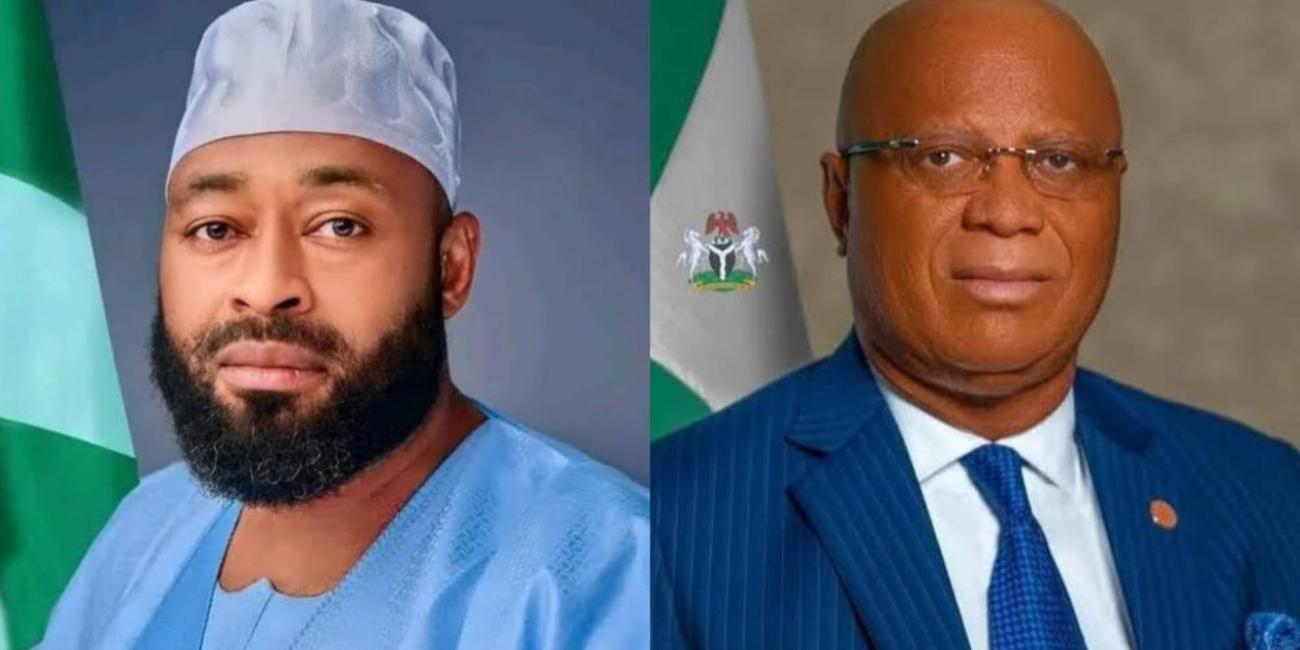
Governors Umar Bago
OpenLife Nigeria reports that Niger and Akwa Ibom state governors, Umar Bago and Umo Eno respectively, have been listed in the “Book of Infamy” by the International Press Institute (IPI) Nigeria as the worst offenders of media repression in the country.
The IPI also included the Inspector General of Police, Kayode Egbetokun, in the blacklist for continued police harassment and attacks on journalists.
This was made known on Tuesday during the IPI Annual Conference in Abuja, attended by Vice-President Kashim Shettima.
At the conference, IPI President Musikilu Mojeed said the governors and the police chief have consistently prevented journalists from performing their legitimate responsibilities.
He said, “Mohammed Umar Bago, Niger Governor, Umo Eno, Governor of Akwa Ibom and the IG of Police, Kayode Egbetokun, are hereby written in the book of infamy.”
Mojeed added that Egbetokun was added for “failing to uphold his constitutional duties and allowing systematic media oppression”.
In recent years, media reports have highlighted multiple instances of repression under the two governors.
In August 2025, Governor Umar Bago ordered the closure of Badeggi FM, a privately owned radio station in Minna, Niger State, accusing it of inciting violence.
The station was sealed by security agents, prompting condemnation from rights organisations such as Amnesty International and the Nigerian Bar Association, which described the move as unlawful and an attack on independent journalism.
Earlier in 2025, a postgraduate student at Ibrahim Badamasi Babangida University, Lapai, Isah Mokwa was reportedly arrested and detained after criticising Governor Bago on social media.
In Akwa Ibom State, under Governor Umo Eno, a Channels Television reporter and cameraman were expelled from the Government House Press Centre in May 2025 after airing a video in which the governor allegedly announced plans to defect from his political party.
We’ll fiercely resist further attacks on Nigerian journalists — IPI
The International Press Institute Nigeria has said that it will resist further attacks on journalists in the country going forward.
The President of the IPI Nigeria, Musikilu Mojeed, said this in his welcome address at the 2025 IPI Nigeria Conference and Annual General Meeting in Abuja on Tuesday.
At the opening ceremony, attended by several dignitaries, including Vice President Kashim Shettima, who served as the Chairman of the occasion, and the Minister of Information and National Orientation, Mohammed Idris, Mojeed said the time had come to check the impunity in the country.
While calling for a review of laws that enable abuse, particularly the cybercrime and outdated criminal defamation provisions, he called on the government to address the culture of impunity in our country.
He said: “There are too many centres of power routinely deploying state powers against journalists without consequences.
“When crimes against journalists go unpunished, the message is dangerous – that silencing the press is acceptable.
“But let us be clear, ladies and gentlemen, Journalism is a tough, risky and selfless public service.
“And if they get nothing for their sacrifices for society, they are at least deserve respect and protection.
“Therefore, any further attack on journalists will be fiercely resisted going forward.”
Mojeed, who referred to the falling of Nigeria by 10 places from 112 to 122 in the global Press Freedom Ranking, said the drop is not the result of one incident.
He said it is the cumulative effect of consistent and aggressive repression across states, across platforms, and across newsrooms, adding that Nigeria is classified as one of West Africa’s most dangerous and difficult countries for journalists.
He said: “This is not a beautiful portrayal of our country, but the description is not baseless.
“Journalists are monitored, attacked, and arbitrarily arrested: Completely lawful reporting activities (filming a demolition, covering a protest, documenting police misconduct) have become dangerous acts.
“Media houses are shut down for political reasons: In Zamfara, four (4) broadcast stations (NTA, Pride FM, Gamji TV, and Al-Umma TV) were once closed simply for airing an opposition rally.
“Investigative journalists face targeted intimidation: We recall the harrowing experience of a colleague, Segun Olatunji, who was abducted, blindfolded, chained, and transported hundreds of kilometres away from his base for a controversial reporting.
“Online reporters are now frequent victims of cybercrime accusations: The cybercrime law, despite recent amendments, continues to be used to suppress digital journalism. Several journalists have been arrested or prosecuted under this legislation.
“Journalists covering protests and elections remain extremely vulnerable: In August 2024 alone, at least fifty-six (56) journalists were assaulted or arrested while covering demonstrations across the country.
“These are not abstractions.
“They have names, faces, and families.
“The pattern of repression is deepening, and the actors remain largely the same—state agents, political actors, and security operatives who operate with impunity.
“This has been said before, and I will say it again: Journalism is not a crime.
“And journalists are not criminals.
“The Constitution protects freedom of expression.
“The courts have affirmed it.
“But in practice, we continue to see arbitrary arrests, intimidation, censorship, and violence.
“To our colleagues across the country: This is not the time for apathy and isolation.
“We must act as a unified community.
“When a journalist is arrested in Kano, colleagues in Akwa Ibom must care.
“When a newsroom is attacked in Niger State, reporters in Lagos must speak out.
“When a reporter disappears in Lagos, editors in Abuja must raise the alarm.
“Solidarity is our greatest line of defence.
“The stakes are high.
“Independent journalism is the lifeblood of democracy.
“When the press is intimidated, elections lose credibility, governance becomes opaque, corruption
flourishes, and citizens lose their voice.
“We must not allow that to become Nigeria’s story.
“We therefore urge the Federal Government to call state governors, security agencies, other officials involved in impunity against media and journalists to order.
“The government should ensure state governors, security agencies, and public officials stop the harassment of journalists: No democracy can function when those who hold power to account are shielded from scrutiny.
“This administration should also strengthen mechanisms for journalist safety: Nigeria has no functioning state protection system for journalists.
“This must change.”
Mojeed, who appreciated the presence of Vice President Shettima and Idris at the opening ceremony, recalled the death of a member of the IPI Nigeria and its former Treasurer, Rafat Salami.
He said: Last year, even in severe pain and confined to a wheelchair, she insisted on attending the conference.
“She greeted guests, coordinated logistics, took photographs with her phone, and served with grace until her body could no longer carry her.
“Her commitment was a reminder that journalism is not merely a job; it is a calling.
“It demands sacrifice.
“It demands conviction.
“To honour her legacy, the Nigerian National Committee of IPI Nigeria will endow a prize in her name at the University of Abuja, her alma mater.
“We will work with the university to ensure that every year, young journalists are inspired by the values Rafat lived by—integrity, courage, and selfless service.”
IPI lists IG, two governors in Book of Infamy, honours DG DSS
The International Press Institute (IPI) Nigeria has listed the Inspector General of Police, IGP Olukayode Egbetokun, and two governors in its Book of Infamy, while honouring the Director General of the Department of State Services (DSS), Adeola Oluwatosin Ajayi.
The Book of Infamy was unveiled by Vice President Kashim Shettima on Tuesday at the second annual conference of IPI Nigeria.
The two governors, who made up the list of three persons to first go into the Book of Infamy, were those of Akwa Ibom State, Imo Eno; and Niger State, Mohammed Umar Bago.
While Egbetokun was said to have failed to heed the calls by IPI to stop the arbitrary arrests of journalists nationwide by his operatives, Eno barred the crew of Channels TV from covering the activities of the Akwa Ibom State Government House.
For Bago, he ordered the closure of Badeggi FM, a private radio station.
Despite the appeal by IPI Nigeria for reconsideration of their decisions, which they had no powers to, both Bago and Eno refused to back down.
For the DG of the DSS, he was described as a listening head of a sensitive government agency who has listened to interventions by the IPI and corrected wrongdoings pointed out to him.
Top on the list of such was the removal from the government’s watchlist of the Executive Director of the International Press Centre, Lanre Arogundade, after 40 years.
Ajayi was also credited with the quick release of journalists wrongly arrested by the secret police.
Responding to the position of the IPI Nigeria, as presented by its President, Musikilu Mojeed, during the unveiling of the Book of Infamy, Vice President Shettima said he would reach out to all those accused of having breached the rights of journalists.
He invited Mojeed to travel with him to Akwa Ibom State, where he would be visiting soon, to resolve the issue Eno had with Channels TV.
He also promised to reach out to Bago, who he described as his friend, and Egbetokun.
Independent press central to functioning democracy — Idris
The Minister of Information and National Orientation, Mohammed Idris, has described a sure-footed, critical, and independent press is the central nervous system of a functioning democracy.
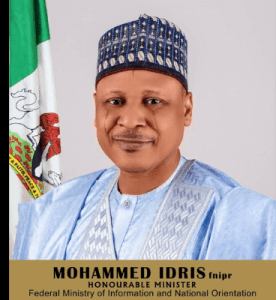
He said this on Tuesday at the second Annual Conference and Annual General Meeting of the International Press Institute (IPI) Nigeria.
Idris, the Special Guest at the event that was chaired by Vice President Kashim Shettima, said the theme of the conference: “Addressing Media Repression in Nigeria,” said it must be weighed against what happened in the past and if it is happening with the present administration.
He said: “As such, it demands our collective reflection.
“But as we gather today, our first duty must be to a shared foundation of facts.
“We must ask: does this theme describe our present reality, or does it risk anchoring us to a sad past we are actively working to transcend?
“If the theme suggests an active, systemic policy of repression by the current administration, then we must, with respect, interrogate it against the available evidence.
“A dialogue on freedom cannot itself be detached from fact.
“It is in that spirit of candour and shared purpose that I stand before you today, not to reel out a list of government achievements, but to present evidence and engage in a critical dialogue about the path we are walking together towards a more accountable and sustainable democracy.
“Let me state without any ambiguity that the administration of President Bola Ahmed Tinubu operates on the fundamental principle that a sure-footed, critical, and independent press is the central nervous system of a functioning democracy.
“It is significantly the mechanism through which a nation holds a conversation with itself.
“Our presence here today, under the chairmanship of His Excellency the Vice President, is a deliberate signal of our commitment to that conversation.”
The Minister said security agencies now operate under stricter protocols to respect the rights of journalists in conflict zones and during civil demonstrations.

He said the Tinubu administration has continued to guarantee the proper assurances of the enabling environment necessary for licensed media establishments to thrive and give more voices to our people without ambiguity or fear.
He added: “We, however, acknowledge that challenges persist.
“The balance between national security, combating misinformation, and upholding absolute press freedom is a complex one, navigated by nations across the globe.
“Our approach to this complexity is the most telling proof of our restraint.
“Let me offer a clear illustration of our principled approach.
“Recently, a major national publication circulated a dangerously false story alleging that a sovereign national agreement compelled Nigeria to adopt LGBTQ+ rights.
“Such disinformation deliberately exploits sensitive cultural and religious fault lines, posing a direct threat to national cohesion by manufacturing a crisis between state policy and deeply held public values.
“In that precise circumstance, the administration’s core priority was resolutely affirmed: to defend press freedom by defending the integrity of the information space upon which it depends.
“We categorically rejected the old playbook of coercion, which would only have inflamed tensions.
“Instead, we pursued transparency, immediately publishing the full, unadulterated agreement to demonstrate its content had no such provisions, issuing detailed rebuttals, and engaging the public directly.
“We channeled the complaint through the independent media ombudsman, respecting its self-regulatory mechanism.
“The result was that a potent falsehood, capable of sowing significant discord, was disarmed by the power of facts and an unwavering commitment to democratic dialogue over division.
“This episode stands demonstrates our restraint and our resolve to protect both social harmony and the press from the corrosive effects of disinformation.
“Our approach, however, is not to retreat into control but to engage through dialogue and build proactive solutions.”
Idris said in moving forward, it was worthy of note that Nigeria has been selected to host the regional Media and Information Literacy (MIL) Institute.
He said the institute will not be a government mouthpiece, but a neutral, pan-African hub for training journalists, educators, and citizens to navigate the digital age, enhance critical thinking, source verification, and ethical reporting from within the country’s cultural context.
He said the ultimate, long-term investment is inoculating the society against disinformation by empowering its people.
He thus extended a formal invitation to every organisation to join in its official unveiling in the first quarter of 2026.
He added: “We remain committed to working with the IPI, the Nigerian Guild of Editors, and the NUJ to review regulatory frameworks, ensuring they protect both free speech and the public good in line with global best practices.
“Distinguished guests and delegates, as one from amongst you who remains true to our shared vision, I leave you with this pledge: I will continue to be an unwavering voice within the Federal Executive Council, championing the cause of a free press and an open society and sustaining our current tempo, moving in the right direction.”
About Author