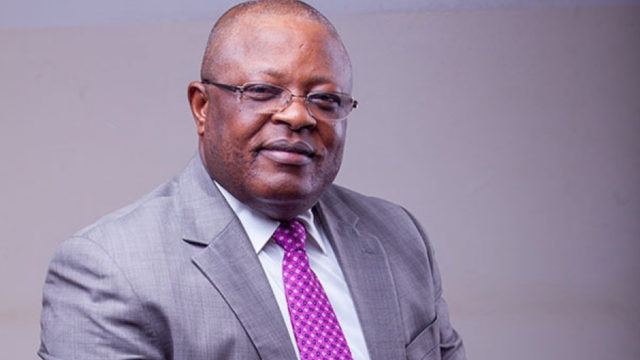
Dave Umahi
OpenLife Nigeria reports that Engineer Dave Umahi who currently serves as Works Minister in President Bola Tinubu’s government is in trouble again.
The trouble, this time, centres around allegation of “exclusion” by Olúwagbénga Oritsẹgbubẹmi Ikúèpènikan, a community development enthusiast.
This is coming shortly after Nigerians expressed dissatisfactions on social media over Umahi’s inability to offer explanation on financial figures on the multi billion dollar Lagos Calabar coastal road project.
Among the Nigerians who frowned at Umahi’s showing on a live TV programme was governor Seyi Makinde of Oyo State.
However, while that rages, Olúwagbénga Oritsẹgbubẹmi Ikúèpènikan has accused the Minister of ‘conspiracy of exclusion,’ in the coastal highway project.
In a statement titled THE COASTAL HIGHWAY AND THE ‘CONSPIRACY OF EXCLUSION’
: A CALL FOR JUSTICE FOR WARRI AND THE NIGER DELTA RIVERINE COMMUNITIES, and signed by Ikúèpènikan, the “Warri son” requests to know the reason genuine coastal communities in Delta are excluded from the project. The statement reads in full:
For years, Warri has been described as the heartbeat of the Niger Delta, a city that not only fuels the nation but also bears the weight of its contradictions — rich in resources yet starved of development.
When President Bola Ahmed Tinubu’s administration announced the Lagos–Calabar Coastal Highway, it was celebrated by many as a beacon of hope for the long-neglected riverine communities of Delta State. It was supposed to be the long-awaited bridge between isolation and progress — a road that would finally connect Ilaje in Ondo, the Warri–Itsekiri axis in Delta, and further into Bayelsa, Rivers, Akwa Ibom, and Cross River.
But suddenly, that hope seems to be slipping away.
A recent revelation from the Honourable Minister of Works, Engr. David Umahi, reported by The Guardian, stated that the Lagos–Calabar Coastal Highway “was originally not designed to pass through Edo State,” but that a miracle happened, and the President directed that the route should now pass through Lagos, Ogun, Ondo, Edo, Delta, Bayelsa, Rivers, Akwa Ibom, and end in Cross River. The Minister even went further to commend Edo State for its support while admitting the route was extended to include Edo.
This raises a critical question — is Edo State a coastal state? The answer is simple and factual: No. Edo is an inland state. So, why should a “coastal highway” — a project specifically designed to run along Nigeria’s coastline — suddenly divert inland? Why bypass the genuine coastal communities of Delta, from Ilaje through Ogheye, Ugbo, and down to Warri and Omadino — areas naturally positioned along the Atlantic coast and the oil-producing creeks?
This shift does not only appear illogical but potentially deliberate — a quiet, bureaucratic erasure of Warri and the entire Delta riverine axis from the national map of development. For decades, these communities have carried the burden of oil production, contributing over 33% of the nation’s crude output.
Yet, they remain surrounded by underdevelopment, poor infrastructure, decaying schools, and unemployment. If there was ever a project that could change the story, it is this coastal highway. But instead of empowering the region that truly deserves it, we are now watching as an inland route — one that benefits political convenience — is being dignified as part of the “coastal” network.
Even the argument that this is merely an additional route does not hold water. Common sense dictates that you first complete the original route — the true coastal path that touches the riverine communities — before expanding inland. What good is a coastal road that ignores the coast itself? What message does it send to the oil-bearing areas that have powered this nation’s economy for over half a century?
It is even more baffling that the Federal Government is willing to pay billions in compensation to real estate developers, companies, and estate owners between Landmark and Winhomes — areas filled with private investments and luxury estates — yet hesitates to extend the same commitment to the Delta creeks, where vast, unused lands stretch freely with no estates or expensive demolitions required.
If the government can compensate the rich for their properties in Lagos, why can’t it invest that same effort in the poor fishing and oil-producing communities whose only crime is being geographically disadvantaged?
Warri and its surrounding Itsekiri, Ijaw, and Ilaje communities deserve better. The Lagos–Calabar Coastal Highway is not just a road; it is a promise — a lifeline that can open the region to investors, reduce the cost of goods and transportation, attract real estate development, create employment, and give meaning to the President’s Renewed Hope Agenda.
The Lagos–Calabar project should not become another symbol of selective progress that benefits the inland at the expense of the coast.
The coastal route through Ilaje, Omadino, Warri, and Koko must be restored to its rightful place in this project. It is not only geographically correct but morally necessary. No government can claim fairness or inclusiveness if it bypasses the very communities that define the essence of the Niger Delta.
The people of Warri and Delta’s coastal belt —
The Oluofwarri Ogiame Atuwatse III,
The Delta State Government,
The Federal Ministry Of Works, Mabuchi, Abuja, FCT , and
The National Assembly representatives of Delta South — must rise to this occasion. The time for silence is over. The time for advocacy is now. Because when development takes a detour away from justice, it becomes a symbol of exclusion — and the Niger Delta has had enough of that.
If this project is to stand as a beacon of progress and not another mark of marginalization, then Warri and its surrounding riverine communities must not be left behind. The Lagos–Calabar Coastal Highway must truly remain coastal — running through the coast, not around it.
Signed:
OLÚWAGBÉNGA ORITSẸGBUBẸMI IKÚÈPÈNIKAN
Concerned and Strategic Son of Warri
Political Scientist | Policy Advocate | Community Development Enthusiast
Warri Kingdom, Delta State, Nigeria
About Author