Heightened Insecurity In Nigeria
OpenLife News reports that in recent months, the level of insecurity in Nigeria has been of serious concern to stakeholders, investors, citizens and the international community.
Between January and March 2026 (Q1 2026), Nigeria experienced widespread insecurity marked by insurgency, banditry, kidnappings, and communal violence, concentrated primarily in the North-East, North-West, and North-Central regions.
Amongst key incidents and casualty figures documented were 492 killings and 651 kidnapping incidents between January and March 2026.
The National Human Rights Commission (NHRC), through its Human Rights Observatory, said it received 659,617 total human rights complaints (up 5% from Q1 2025).
Independent and media tracking reported even higher fatality and abduction totals across various regions.
North-East: Boko Haram, ISWAP Intensify Attacks
In the North-East, insurgent activity by Boko Haram and ISWAP intensified, especially in Borno and Adamawa states.
On March 4, 2026, insurgents overran a military base and attacked the Ngoshe community in Gwoza LGA, Borno State, killing over 100 civilians and at least nine soldiers while abducting more than 300 women and children.
Additional attacks hit military bases near Maiduguri on March 5 and caused 23 deaths and over 100 injuries in Borno on March 16.
North-Central & North-West: Killings, Abductions Persist
Similarly, in the North-Central and North-West, violence and abductions persisted. Reports put killings in Plateau State alone at at least 119 during the three-month period.
Expectedly, these sad occurrences resulted in conflict, economic hardship, and climate shocks worsening humanitarian conditions in the BAY states (Borno, Adamawa, Yobe) and Plateau State by March 2026.
There were increasing displacement and protection risks for women and girls while disrupting access to essential health services.
There were fire outbreaks in displacement camps and host communities in Borno and Yobe, further straining aid responses.
To arrest the situation, states and federal authorities continued heavy security outlays amid ongoing violence; reports have it that 31 states spent N252 billion on security over a six-month period spanning the broader security drive.
Yet, despite the spending, ordinary Nigerians remained exposed on highways, in farms, in markets and in their homes.
The Okosun Brothers’ Pathetic Experience
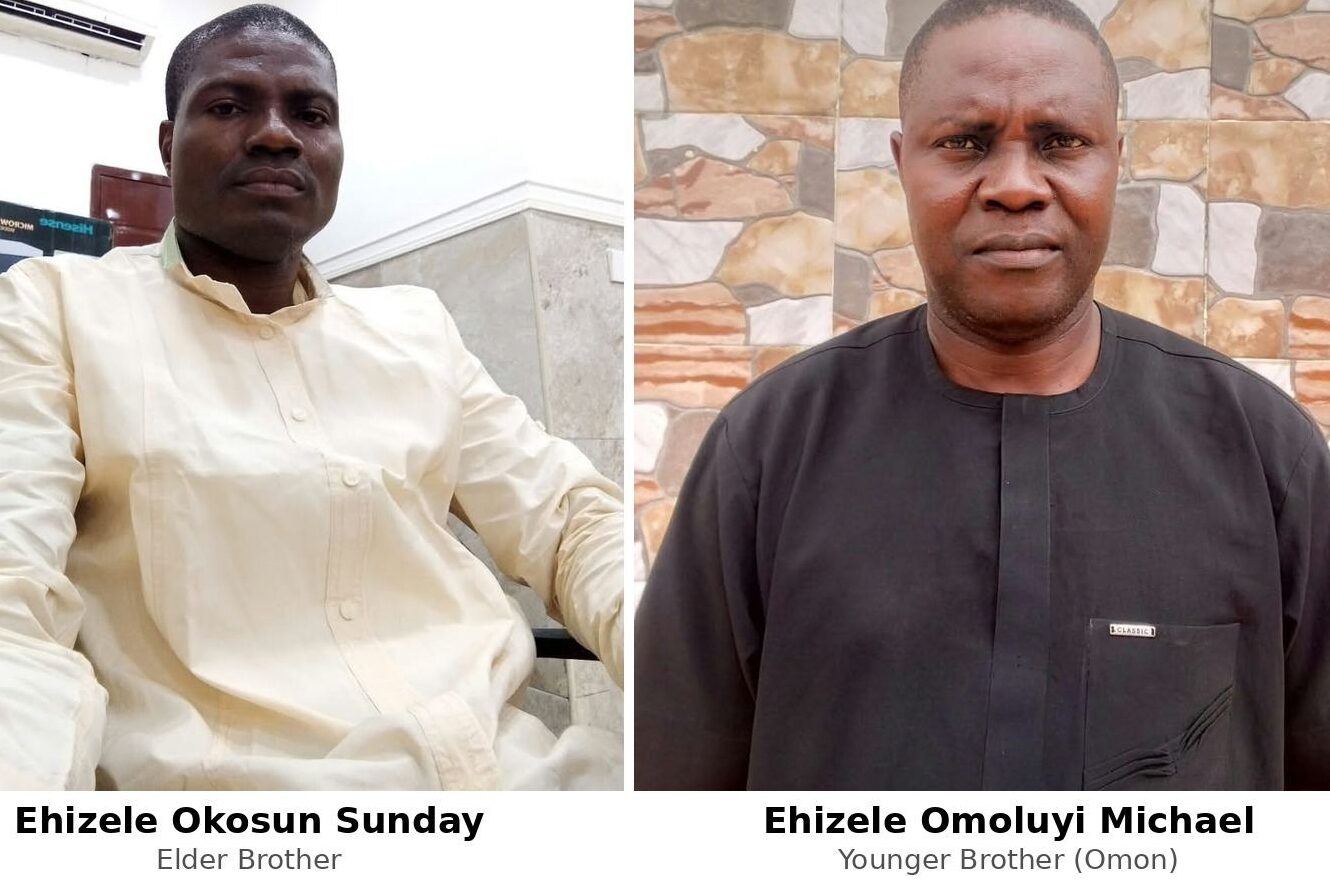
It is against this grim national backdrop that the case of Ehizele Okosun Sunday and his younger brother, Ehizele Omoluyi Michael, provoked interest in the public space in March. Their story shows not only how easily Nigerians are kidnapped, but how escape from kidnappers does not end the danger.
For victims, life after escape becomes further endangered – no phone, no money, no identity, no protection, and no system to receive them.
How It Happened
It was a quiet Sunday evening on March 15, 2026 when Ehizele Okosun Sunday decided it was time to return to Lagos. He had travelled to Ibadan the previous day to spend some time with his younger brother, Ehizele Omoluyi Michael, and his wife.
It had been a pleasant visit, but Monday morning was approaching, and work would not wait for him.
Omon, however, had his own plans. His wife’s shop needed fresh stock, and since he had to buy goods in Lagos, he decided to travel with his elder brother and return to Ibadan later in the week.

They eventually boarded a Toyota Sienna at the toll gate along the Lagos-Ibadan Expressway, sometime around 5:30 p.m that fateful March 15 evening.
The bus was filled with different kinds of passengers including traders, workers and a young couple.
Nothing about the journey suggested that anything unusual was about to happen.
The driver was quiet, occasionally exchanging a few words with passengers. His assurance was simple to the effect that if the road remained free, they should get to Berger in Lagos before it became too late.
The evening sun was gradually disappearing as they made their way along the Ibadan-Lagos expressway.
Traffic was moving reasonably well, and everyone seemed settled into the journey.
Then, somewhere around the Fidiwo axis, just after the long bridge, the unexpected happened. The vehicle slowed down. Cars ahead were no longer moving. The driver muttered something under his breath and attempted to reverse. But it was already too late.
Men suddenly emerged from the thick bush. They were at least eight in number, dressed in camouflage jackets and dark trousers. Two carried what appeared to be long rifles, while others had cutlasses and a shotgun.
One of them fired into the air. That was enough to send everyone into panic. Passengers screamed and scrambled for safety. Some dropped to the floor of the vehicle. The gunmen moved quickly, dragging people out and shouting instructions.
Okosun felt a firm grip on his shoulder. Omon was right behind him. Neither brother knew what to say or what to expect. Before long, three passengers, including Okosun and Omon, had been taken away. The others were ordered to run.
Inside The Kidnappers’ Camp
The brothers and the third captive were pushed into the bush. They walked along a narrow, damp path, surrounded by thick vegetation. With every step, the sound of passing vehicles became fainter until the highway was completely out of earshot.
Nobody dared to speak. Whenever anyone slowed down or stumbled, the gunmen responded with a shove or a threat. After what seemed like a very long walk, they arrived at a clearing deep inside the forest.
It was a makeshift camp. There were tarpaulin shelters, a few plastic chairs and the remains of a fire. Other captives were already there, sitting on the ground with their hands tied. The men appeared comfortable in their surroundings, as though this was a place they knew very well.

An older man seemed to be in charge, giving instructions while the younger ones kept watch. The first thing they did was collect everyone’s phones. Okosun’s phone and Omon’s phone were thrown into a black bag with the others.
“You go call your people. Make dem pay,” one of the men said. That was when the reality of their situation began to sink in. Their wives had no idea what had happened. Neither man had had the opportunity to call home.
Now their phones were in the hands of the very people holding them hostage. That night was particularly difficult. The brothers sat close to each other, their hands tied, their backs resting against a tree. Mosquitoes were everywhere.
A guard walked around with a torch, occasionally shining it in the direction of the captives. Somewhere in the distance, gunshots rang out.
Food was hardly worth calling a meal. They were given cold garri to share and water from a jerry can.
Sleep was almost impossible.
Okosun kept looking in Omon’s direction. He was worried about his younger brother, but there was little he could do beyond making sure he was still okay.
Omon, on his part, remained unusually quiet. His eyes stayed open long after the others had settled down.
Morning eventually came, but it brought little relief.
The second day passed slowly. The kidnappers changed shifts, and some went out on motorcycles, returning later with supplies.
The captives were occasionally allowed to stand and stretch, although they remained under close watch.
During one of those moments, Okosun began to observe his surroundings more carefully.
He noticed a few faint paths leading away from the camp and disappearing into the trees. He said nothing, but he kept looking. Perhaps, somewhere in his mind, he was already thinking about an opportunity to escape.
The Daring Escape
That opportunity came later that evening. A new guard took over from the others. He was a younger man, and it did not take long to notice that he had been drinking heavily.
He dragged a plastic chair close to where the captives were seated, rested his rifle across his lap and began muttering to himself.
Within a short while, his eyes became heavy. His head dropped forward, and before long, he was fast asleep. Okosun noticed. He looked towards Omon. Their eyes met. There was no need for a conversation. They both understood what that moment could mean.
Earlier, when the guards were not paying much attention, they had quietly worked on the knots around their wrists. Omon had managed to loosen his rope, and he was now able to slip his hands free. He moved cautiously and helped Okosun do the same.

For a few moments, they simply sat there, looking at the sleeping guard. They knew that one wrong move could cost them their lives. But staying there was no longer an option they could comfortably accept. They rose slowly, careful not to make a sound, and began moving towards the darker part of the forest.
Once they were far enough from the camp, they started running. They ran without knowing exactly where they were going. Branches scratched their faces and tore at their clothes. Roots and undergrowth made every step difficult. They stumbled, picked themselves up and kept going.
Then they heard a shout from behind. A gunshot followed. Fear took over completely. They did not stop to find out whether the bullet was meant for them or whether the gunmen had even seen them. They simply kept running.
For a long time, they moved through the thick vegetation, sometimes following faint footpaths and at other times making their own way through the bush. They had no idea how far they had gone or which direction they were heading. Their only concern was to put as much distance as possible between themselves and the kidnappers.
As the hours passed, exhaustion began to set in. Their legs were aching, their throats were dry, and every sound from the surrounding bush made them nervous. Yet stopping was not an option. They occasionally paused to catch their breath, listened carefully for any sign of pursuit and continued their journey.
Gradually, the forest began to give way to less dense vegetation. They came across a few scattered signs of human habitation, then what appeared to be a rural access path. They followed it, hoping it would lead somewhere safe.
Escape Is Not Safety: Life Further Endangered
By this time, several hours had passed since their escape. Eventually, after a long and exhausting journey through the bush and adjoining rural communities, they found themselves approaching the outskirts of Ikorodu in Lagos.
At first, they were not entirely sure where they were. Then they began to recognise the familiar signs of civilization including streetlights, passing vehicles, buildings and the unmistakable noise of a busy town.
They had finally made it out. But escape did not mean safety. Their clothes were torn and dirty. Their wrists were bruised from the ropes, and they were completely exhausted. They were hungry, thirsty and desperately in need of help.
A passing keke rider noticed them and slowed down. The brothers struggled to explain what had happened. They told him they had been kidnapped and had somehow managed to escape from the bush. They asked if they could borrow his phone to contact their families, but the request did not yield any result.
They tried again with a few other people, hoping someone would be willing to help them make a call. Unfortunately, nobody was prepared to lend them a phone. Perhaps people were understandably suspicious. Two dishevelled men, looking exhausted and telling a story of kidnapping, were not exactly the easiest strangers to trust.
This is the second danger escaped victims face in Nigeria. After surviving the kidnappers, they must survive public distrust, with no phone, no money, no identification, and no police post to run to.
However, their situation soon attracted the attention of some local vigilantes and members of the public.
After listening to their account and seeing the condition they were in, these people took pity on them and offered assistance.
Between the local vigilantes and a few compassionate men and women, they were able to gather a few naira notes, amounting to approximately ₦4,000. It wasn’t much, but at that moment, it meant a great deal.
For two men who had just escaped from the hands of kidnappers, those little contributions were more than money.
They were gestures of kindness from strangers at a time when the brothers desperately needed help.
They had no phones, no personal belongings and no immediate way of reaching their wives. But they were grateful to have found people willing to help. After a brief rest, they decided to use the money to make their way towards Iyana Ipaja, where Okosun lived.
The journey ahead was still uncertain, but at least they were no longer in the hands of the kidnappers.
They were heading home, however difficult the journey might be. One can only imagine what their wives must have been going through.
Since the incident happened, neither woman had been able to reach her husband. There had been no calls, no messages and no explanation for the sudden silence. Unknown to them, their husbands had been fighting for their lives.
As Okosun and Omon made their way towards Iyana Ipaja, they hardly spoke to each other. Perhaps there was simply too much to process. The damp smell of the forest was still on their clothes.
The marks of the ropes remained on their wrists. And somewhere in their minds, they could still hear that gunshot behind them.But they were alive.They had escaped.And, most importantly, they had escaped together. For the first time in days, Okosun and Omon could breathe freely again.
Their case captures the tragedy of Nigeria’s insecurity in Q1 2026.
The Threats And Fears
Now, Okosun and Omon live in perpetual fear. Within a week of their escape, they decided to retrieve their mobile phone lines. Getting new lines was completely out of the question.
Friends, family members and customers would find it difficult to reach them if their old numbers were not reactivated.
But that decision became the avenue for the kidnappers to reach them again.
The kidnappers began to call and threaten them with another kidnap. “You escape abi. You think you can run away after marking our faces.
“We know you will give information about us to the security agents so that they would come and arrest us. Well before they come and kill us, we will kidnap you again. We will trace you,” said the kidnappers.
Their fear was that the brothers had already recognised their faces and could give descriptive information to security agents about their kidnapping activities.
That is now the prevailing fear of Okosun and Omon, who can no longer move freely for fear of being traced by their kidnappers.
And if that happens, they are not sure of coming out alive. Citizens are kidnapped on major highways, held in forest camps in plain sight of a failing security architecture, and when they escape, they are left to face another phase of fears.
For Okosun and Omon, escape was not freedom. It was the beginning of a new life of hiding, watching, and waiting.
They are not sure if the next call, the next stranger, or the next journey could be the one that returns them to the forest.
About Author