What Is The Future Of AI With Or Without Jensen Huang, Rene Haas?
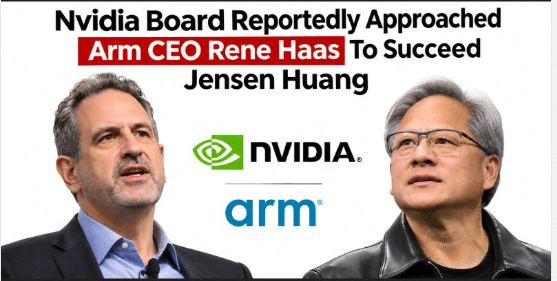
OpenLife News reports that for thirty-three years, Jensen Huang was the voice of Nvidia. Now, with the board weighing his future and Arm CEO Rene Haas approached as a potential successor, the $5.4 trillion AI empire faces its biggest question:
What is the future of AI with or without Jensen Huang — or with Rene Haas? Nvidia is no longer a chip company. It sells AI factories.
But after a November 2026 boardroom reckoning, with CFO Colette Kress as interim CEO, the company must decide whether its future is secure with its prophet, its priest, or neither.
Technically, it was not a product launch that shook Silicon Valley. It was a silence. For thirty-three years, one man had been the voice of Nvidia.
One man in a black leather jacket, walking the stage like a preacher, telling the world that the future would not be built — it would be manufactured.
His name was Jensen Huang. And then, in November 2026, the voice went quiet.The boardroom at Nvidia, the most valuable company on earth, was suddenly filled with a question no one had dared to ask out loud: What happens when the prophet leaves?
Chapter One: The Man Who Saw It First
Jensen Huang did not invent the GPU.He invented the reason for the GPU. In the 1990s, when Nvidia was a gaming company fighting for survival, Huang bet everything on a strange idea called CUDA — that a graphics chip could think.
The world laughed.Then, in 2012, a neural network called AlexNet learned to see. It ran on Nvidia. In 2017, Transformers learned to speak. They ran on Nvidia. In 2022, ChatGPT learned to reason. It ran on Nvidia.
Huang had not just built a chip. He had built the church.“AI has reached its inflection point. It’s doing useful work. Its tokens are productive and profitable. Now, compute is revenue.” He called it the AI Factory. Not a computer. A factory that manufactures intelligence.
By September 2026, that factory was worth $5.4 trillion — more than Apple, more than Microsoft, more than Alphabet. Nvidia was no longer selling to gamers. It was selling to nations. To Saudi Arabia. To India. To Germany. To anyone who wanted sovereignty in the age of AI.
Huang was not a CEO anymore. He was a prophet. And prophets, as history teaches us, are dangerous to lose — and dangerous to keep.
Chapter Two: The Fall
No empire falls because of a competitor.It falls because of a crack inside. In November 2026, reports emerged of a boardroom reckoning. Of affairs. Of an inquiry into possible foreign intelligence targeting.
Of a woman linked to a Singapore data centre operator, suspected by US intelligence of working for China’s Ministry of State Security.
The details were murky. The damage was not.NVDA stock fell 7% in a week, heading for its sixth straight weekly loss. The board reportedly weighed removing Huang.
And for the first time, the question was no longer if Nvidia needed a successor. It was who — and how fast.CFO Colette Kress stepped in as interim CEO. The faithful waited.
Some staff, it was reported, were urging the company to bring Huang back. But the board had already made a call that stunned the industry: it had approached another man.
A man who had once worked for Huang.A man who now ran the company that powers 99% of the world’s smartphones. His name was Rene Haas.
Chapter Three: The Priest
If Huang is the prophet, Haas is the priest. Haas does not preach on stages in leather jackets. He builds liturgy. He writes the rules that everyone else follows.
For seven years, he worked inside Nvidia. He ran its computing products business. He saw Huang up close — his brilliance, his fury, his refusal to plan for succession.”He didn’t like the idea,” Haas recalled in a 2024 interview. “He felt it would create competition among executives and be divisive.” Haas left in 2013. He went to Arm.
And there, he did something Huang never could: he became neutral.Arm does not sell chips. It sells permission to build chips.
Its designs are inside Apple iPhones, Amazon servers, Qualcomm phones, and — ironically — inside Nvidia’s own Grace and Vera CPUs.Haas became the man everyone had to work with, even if they hated each other.
In 2022, he became CEO. In 2023, he took Arm public. In 2026, he did the unthinkable: he launched Arm’s first-ever server processor — the AGI CPU.
It was a direct challenge to Intel and AMD. And a quiet challenge to Nvidia.Meta signed on as lead customer. The chip would run alongside Nvidia’s Vera accelerator.Haas insisted it was not war.
It was complement.“Together we’re creating one seamless platform, from cloud to edge to AI factories,” Huang had said of Arm’s launch. But in Silicon Valley, everyone heard the subtext: The priest is building his own church.
Chapter Four: Two Futures, Two Religions
The AI war has split into two religions.The Religion of Huang: Training is everything. Build bigger factories. More GPUs. More power. More tokens.
If you want intelligence, you must manufacture it at scale. Nvidia sells scarcity. A single H100 for $25,000-$30,000. A rack for millions. A factory for billions.The Religion of Haas: Orchestration is everything. The future is not training. It is agents — small, autonomous AIs that work, decide, and act. Agents don’t need a supercomputer.
They need a brilliant, efficient CPU. Arm sells ubiquity. Cents per chip. Billions of devices. 350 billion chips shipped. One is depth. The other is breadth.
One is the cathedral. The other is the parish.And the terrifying truth for Nvidia is this: It needs both.Even Nvidia’s most advanced system, Grace Blackwell, contains 72 Arm CPUs.
Without Haas’s architecture, Huang’s factory has no brain to coordinate its muscle. Without Huang’s GPUs, Haas’s AGI CPU has no muscle to coordinate. They are rivals. They are partners. They are inseparable.
Chapter Five: The Succession Gamble
The traders have already voted. On Polymarket, Ian Buck — the inventor of CUDA, Nvidia’s true technical soul — led the bets for next permanent CEO at 38%. Kress was at 28%. Haas had fallen from 25% to 5%.
Why so low for Haas?Because the gap is enormous. Arm has about 10,000 employees and $4.9 billion in revenue. Nvidia has about 42,000 employees and $215.9 billion in revenue.
Haas has never run NVLink. He has never run Mellanox. He has never run a rack-scale AI system.And he carries a poisoned chalice: He is also in line to lead much of SoftBank’s international business.
SoftBank once tried to buy Arm — and Nvidia once tried to buy Arm too. If Haas became Nvidia CEO, he would be the man who tried to sell a rival CPU to Nvidia’s own customers, now running Nvidia. Would Amazon trust him? Would Meta trust him? Would Google?
But the analysts who know him best say something else.Tae Kim, author of The Nvidia Way, named Haas as one of the two strongest candidates: “A strong grasp of technology, a public-facing CEO skill set, and well-regarded business management experience.”
And Shay Boloor of Futurum Group put it bluntly: “If I had to put money on which external candidate could become next NVDA CEO then it would be ARM CEO Rene Haas. He spent 7 years at Nvidia and understands Jensen’s culture… he understands CPU side of Nvidia’s platform better than almost anyone else on the outside.”
Haas is not the safe choice. He is the interesting choice.
Chapter Six: Will Nvidia Lose Both?
This is the nightmare scenario the board fears most.
Scenario A: Huang Leaves, Haas Says No. Nvidia loses its prophet. It keeps its engineers, but loses its storyteller. The stock wobbles. Competitors — AMD, Broadcom, and the hyperscalers building their own chips — smell blood.
Scenario B: Huang Leaves, Haas Comes. Nvidia gains a stabilizer, but loses its prophet’s magic. Engineers who worshipped Huang may leave. And Arm loses its priest, destabilizing the very ecosystem Nvidia depends on.
Scenario C: Huang Stays, Haas Stays. The status quo. But the boardroom crisis has already cracked the myth of invincibility. Huang can no longer be the company. He must become replaceable.
Scenario D: The One Everyone Whispers About. Huang returns — not as a king, but as a founder-chairman. Haas — or Buck — runs the day-to-day. The prophet keeps the vision.
The priest keeps the order.That is how Apple survived Steve Jobs. That is how Microsoft survived Bill Gates. That is how religions survive their founders: they turn prophecy into institution.
Epilogue: The Future of AI
So, what is the future of AI — with Huang, or with Haas?The honest answer is: AI does not belong to either man anymore. It belongs to the 5 million developers who write in CUDA.
It belongs to the 350 billion Arm chips already in the world.
It belongs to the gigawatts of power being built in deserts and data centres from Texas to Riyadh.
Huang made AI inevitable. Haas is making AI everywhere. If Nvidia loses its prophet, it will hurt. If it loses its priest, it will hurt more. But if it loses both — if it loses the vision and the discipline, the fire and the structure, then it will lose the very thing that made it $5 trillion.
The belief that one company could manufacture intelligence for the whole world.
The question is no longer: Huang or Haas? The question is: Can Nvidia become a church that survives its founder? Because every prophet eventually leaves. The only ones who live forever are the ones who build something bigger than themselves.
And right now, in a quiet boardroom in Santa Clara, that is the only story that matters.
Clearer Picture In Questions & Answers
Q: Is Jensen Huang leaving Nvidia?
A: Reports in November 2026 said Nvidia’s board weighed removing Jensen Huang after a second affair report and an inquiry into possible foreign intelligence targeting.
CFO Colette Kress is serving as interim CEO while the board searches for a permanent successor. Some staff are reportedly urging the company to bring Huang back.
Q: Is Rene Haas going to be the next Nvidia CEO?
A: The Financial Times reports Nvidia’s board has approached Arm CEO Rene Haas as a potential successor. Haas spent 7 years at Nvidia before leaving in 2013.
He is considered a strong external candidate, but traders give him low odds at 5%, behind Ian Buck (38%) and Colette Kress (28%).
Q: Who is Rene Haas?
A: Rene Haas is CEO of Arm Holdings since 2022. He led Arm’s IPO in 2023 and launched its first server processor, the AGI CPU, in 2026. He previously worked at Nvidia for 7 years running its computing products business.
Q: What is the future of Nvidia without Jensen Huang?
A: Analysts say Nvidia has a deep bench of talent and can thrive under a new CEO if it is the right leader. Its moat is CUDA, NVLink, TSMC supply, and $100B+ in purchase commitments. Short-term, Huang’s vision is hard to replace. Long-term, Nvidia needs institutional discipline to survive its founder.
Q: What is the difference between Nvidia and Arm in AI?
A: Nvidia dominates AI training with GPUs and AI factories. Arm dominates AI orchestration and agentic AI with energy-efficient CPUs licensed to billions of devices. Nvidia sells depth (high-margin hardware), Arm sells breadth (low-cost licensing at massive scale). Nvidia’s Grace Blackwell itself uses 72 Arm CPUs.
Q: Will Nvidia lose both Huang and Haas?
A: That is the nightmare scenario. If Huang leaves and Haas declines or fails, Nvidia loses its visionary and fails to secure its stabilizer.
If Haas leaves Arm for Nvidia, Arm also loses its leader. The safest path analysts suggest is Huang as founder-chairman with a Haas-type operator running day-to-day.
About Author