Tee Mac
OpenLife News reports that when Dr. Tee Mac Omatshola Iseli speaks, the world listens.
This is not simply because he is an internationally acclaimed flutist, composer and MFR honoree, but as a philosopher who has spent a lifetime searching, questioning and discovering the deeper music of existence.
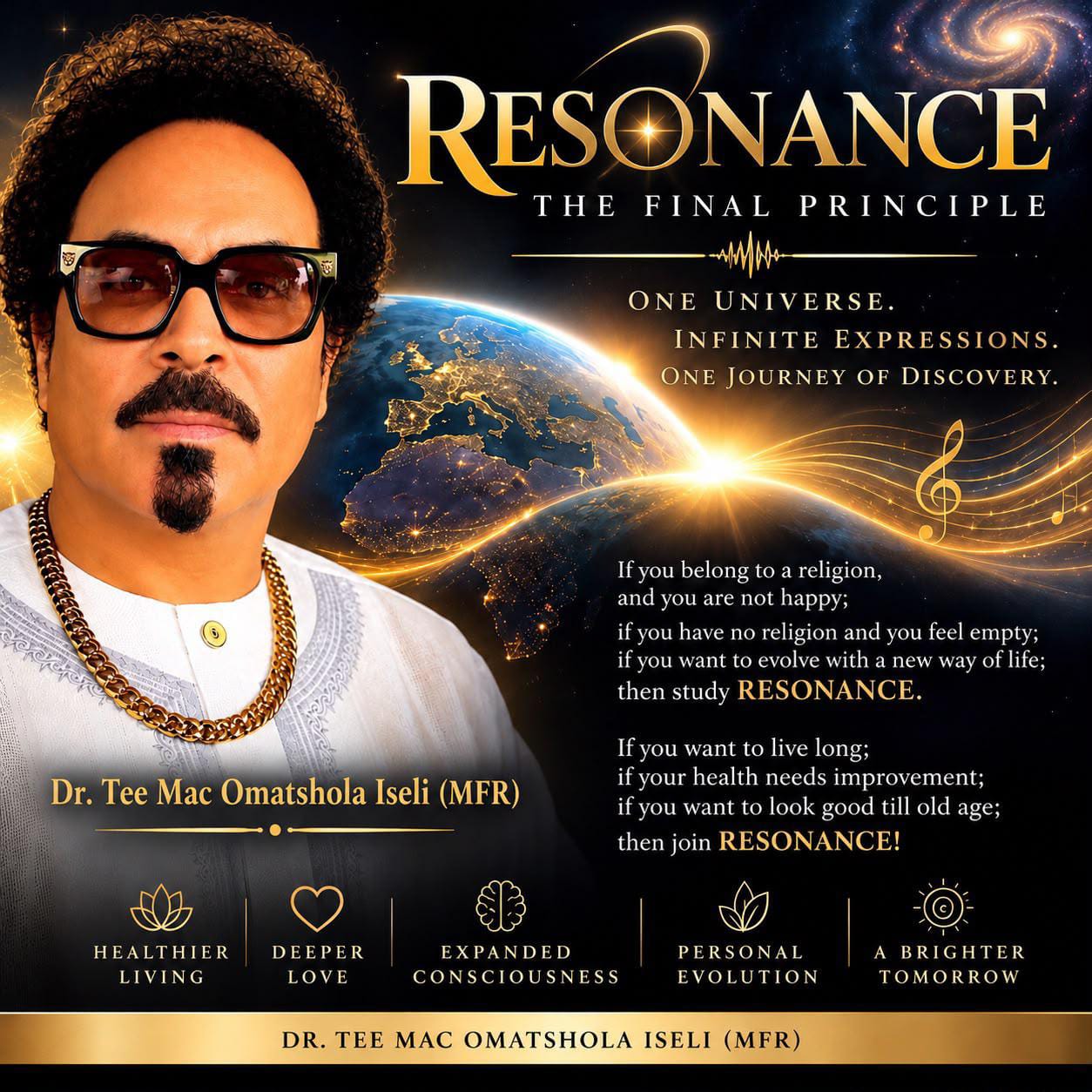
As founder of RESONANCE — THE FINAL PRINCIPLE, the cultural icon distills his life’s work into one profound truth, saying “We are the microcosm of the macrocosm, inseparable expressions of the Universe itself.”
In this exclusive interview with OpenLife Magazine, the legendary musician turned philosopher unveils the vision behind RESONANCE and its five pillars of Healthier Living, Deeper Love, Expanded Consciousness, Personal Evolution and A Brighter Tomorrow.
For him, it is not another religion or doctrine, but a call to live as tuned instruments — learning to harmonize our thoughts, emotions and actions with ourselves, humanity, nature and the Universe within us.
Excerpts
For the benefit of OpenLife’s local and international audience, could you explain what RESONANCE is all about, including its philosophy, vision and driving force?
RESONANCE is the culmination of a lifetime of searching, questioning, observing, learning and discovering.
It is a philosophy of life founded upon one profound understanding: We are the microcosm of the macrocosm. The Universe is not merely around us; we are an inseparable expression of it.
I have given this philosophy a defining identity:
RESONANCE — THE FINAL PRINCIPLE.
-ONE UNIVERSE.
-INFINITE EXPRESSIONS.
-ONE JOURNEY OF DISCOVERY.
For centuries, humanity has searched for answers to the fundamental questions of existence. Who are we? Why are we here? What is consciousness? What is our relationship with the Universe? Why do we experience love, suffering, happiness, fear and the desire for immortality?
Religions have attempted to answer these questions through faith and revelation. Philosophers have approached them through reason. Scientists have investigated them through observation, experimentation and discovery.
RESONANCE invites us to explore these different approaches while recognising that our understanding of existence remains incomplete.
My philosophy begins with a simple proposition: every human being is an instrument, and every life produces a resonance.
As a musician, I understand resonance in its physical reality. When a musical instrument vibrates, it produces sound. When instruments are properly tuned, they can create extraordinary harmony.
I believe human existence offers a powerful philosophical parallel. Our thoughts, emotions, decisions, relationships and actions influence the quality of our lives and the world around us.
RESONANCE is therefore about learning to live in greater harmony with ourselves, with other human beings, with nature and with the extraordinary Universe of which we are part.
At its heart are five principles:
Healthier Living: Caring for the body through responsible nutrition, physical activity, rest, discipline and preventive healthcare.
Deeper Love: Recognising compassion, kindness, forgiveness and genuine human connection as essential foundations of a meaningful life.
Expanded Consciousness: Developing awareness through learning, meditation, contemplation, critical thinking and self-examination.
Personal Evolution: Understanding that we are not finished products but beings capable of continuous intellectual, emotional and spiritual growth.
A Brighter Tomorrow: Applying our individual development to the creation of a more compassionate, peaceful and enlightened society.
RESONANCE does not demand that anyone abandon their religion. Neither does it require belief in a supernatural authority or submission to another doctrine.
It asks only that we remain curious, courageous and willing to discover.
My driving force is the conviction that humanity has enormous unrealised potential.
I want people to understand that a meaningful life does not begin with the promise of another world. It begins with how consciously, lovingly and responsibly we live in this one.
The Universe is within you. The journey begins with you.
You are an internationally acclaimed flutist, a former President of the Performing Musicians Association of Nigeria (PMAN), and you played a pivotal role in the establishment of the MUSON Centre. Given your towering profile as an entertainer, at what point did RESONANCE come into your horizon, and how did it evolve into a way of life for you?
RESONANCE did not come to me as a sudden revelation. It evolved gradually over many decades of personal experiences, spiritual exploration, musical discovery and intellectual questioning.
Although the philosophy now has a name and a clearly defined structure, its foundations were established long before I began writing about it.
My journey has taken me through different cultures, countries, religions and philosophical traditions.
For approximately twenty years, I was deeply involved in the Hare Krishna movement. I subsequently studied aspects of Buddhism, including the Lotus Sutra, as well as Islamic teachings, Sufi philosophy and other spiritual traditions.
I have also had personal encounters with remarkable religious personalities, including the late Prophet T.B. Joshua, whom I knew for many years.
I approached these experiences with an open mind, searching for understanding rather than simply accepting inherited beliefs.
Eventually, I arrived at an important personal conclusion: I was searching outside myself for something I needed to discover within myself.
I was searching for the Universe within me — the microcosm of the macrocosm.
Music played an extraordinary role in this discovery.
As a classical flutist and composer, I have spent much of my life studying the relationship between sound, vibration, harmony, rhythm and emotion.
When I perform a beautiful composition, particularly one by a great classical master, I experience something that transcends ordinary language.
Music can move people to tears, awaken forgotten memories, create joy and establish an emotional connection between individuals who may not even speak the same language.
This fascinated me.
I began reflecting upon the possibility that harmony, understood as a philosophical principle, might offer valuable insights into human existence.
Just as musical harmony depends upon relationships between different notes, perhaps a harmonious life depends upon the relationships between our physical health, consciousness, emotions, actions and environment.
Over time, this became a practical way of living.
I have maintained a largely vegetarian lifestyle for more than five decades. I believe in physical exercise, intellectual curiosity, musical discipline, meditation, emotional balance and continuous learning.
Now, in my seventy-ninth year of life, I remain active as a musician, composer, entrepreneur and thinker.
I do not regard ageing as the end of personal evolution. I regard every additional year as another opportunity to learn, create and contribute.
RESONANCE is therefore not a philosophy I invented simply to write a book.
It is the philosophical expression of the life I have been attempting to live.
And perhaps my greatest discovery is that the more we learn about existence, the more we recognise how much remains unknown.
That realisation should inspire humility, not fear.
Through the core principles of RESONANCE — Healthier Living, Deeper Love, Expanded Consciousness, Personal Evolution and a Brighter Tomorrow — what key message do you want the world to take away or imbibe from these?
My central message is that human beings possess a remarkable capacity for growth, but that growth requires conscious participation.
We cannot expect our lives to improve merely through prayer, wishful thinking or waiting for circumstances to change.
We must take responsibility for our own development.
The first responsibility is to our bodies.
Our bodies are extraordinary biological systems, the products of billions of years of evolution. We should treat them with intelligence and respect.
Good nutrition, regular physical exercise, adequate sleep, responsible medical care and avoidance of destructive habits can significantly improve our prospects for healthier ageing.
The second responsibility is to love.
I describe love as the most sublime and powerful frequency of human existence. I use the word frequency here in a philosophical and poetic sense, rather than as a scientifically established electromagnetic measurement.
Love has the capacity to transform relationships, overcome hatred, inspire forgiveness and give meaning to our lives.
A society that has technological sophistication but lacks compassion has not achieved genuine human progress.
The third responsibility is the expansion of consciousness.
By this, I mean developing a greater awareness of ourselves, our thoughts, our motivations and our relationship with the world.
Science has made extraordinary progress in understanding the brain, yet the full nature of subjective consciousness remains one of humanity’s great intellectual challenges.
RESONANCE encourages people to explore this mystery through scientific knowledge, philosophical reflection, meditation and honest personal observation.
The fourth principle is personal evolution.
I believe that nobody should stop developing simply because they have reached a particular age, achieved financial success or acquired a religious identity.
At nearly eighty years of age, I am still learning, composing music, exploring new technologies and developing new ideas.
The fifth principle is our collective responsibility to create a brighter tomorrow.
Imagine a society in which people are healthier, more compassionate, better educated, more conscious of their environment and less divided by religious or ethnic hostility.
Such a society would not emerge through miracles. It would emerge through the accumulated decisions and actions of individuals.
Ultimately, I want people to understand one essential truth:
You are not a passive spectator in the story of your existence. You are an active participant in the unfolding story of the Universe.
And the quality of your participation matters.
What is your objective assessment of the ongoing political activities and realignments across party lines ahead of the 2027 general elections?
I observe the political developments ahead of the 2027 general elections with considerable concern.
What I see is an atmosphere of political uncertainty, shifting alliances, personal rivalries and intense competition for power.
Political realignments are not necessarily unhealthy in a democracy. Politicians have the right to change parties, form alliances and reconsider their positions.
However, I believe such decisions should be guided by clear principles, policy objectives and a genuine commitment to public service.
My concern is that too much political activity appears to revolve around personalities, access to power and electoral calculations rather than the urgent challenges facing ordinary Nigerians.
Our country needs serious discussions about economic development, employment, education, healthcare, security, infrastructure and the future of our young people.
These issues should dominate the national conversation.
I am particularly concerned about the possibility of political tension, electoral disputes and violence as 2027 approaches.
I sincerely hope these concerns prove unfounded.
Nigeria cannot afford another election season characterised by widespread mistrust and confrontation.
The Independent National Electoral Commission, security agencies, political parties and the judiciary must discharge their responsibilities transparently and impartially.
Citizens must be able to vote freely, and the electoral process must command public confidence.
At this stage of my life, I am less interested in political personalities than in the future of Nigeria.
Democracy must be about the welfare and dignity of the people, not merely the acquisition and retention of political power.
Are you currently affiliated with any political party?
No. I am not presently a member of any political party.
I have participated in political activities in the past because I believe responsible citizens should take an interest in the direction of their country.
During the 2023 presidential election, I openly supported Peter Obi.
My involvement was not superficial. I participated in fundraising concerts and served on an elders’ advisory committee supporting his presidential ambition.
I believed that his candidacy represented an opportunity for a different approach to governance.
Like many of his supporters, I was deeply disappointed by the outcome of the election and remained dissatisfied with aspects of the electoral process.
I respect the fact that the officially declared result and subsequent judicial decisions established a different outcome from the one I had hoped for.
Nevertheless, those experiences contributed to my decision to withdraw from active party politics.
I have reached a stage in life where I prefer to devote my energy to music, cultural development, community service, business initiatives and, above all, the advancement of RESONANCE.
This does not mean that I have abandoned my concern for Nigeria.
On the contrary, I remain deeply interested in the country’s future and will continue to speak independently on matters of national importance.
But I do not believe that one must belong to a political party to contribute meaningfully to society.
My allegiance today is to my conscience, to the principles I believe in, and to the wellbeing of humanity.
What is your present relationship with Senator Oluremi Tinubu, in light of the reported frosty political alliance in 2023, and how would you describe your relationship with Governor Sheriff Oborevwori, considering your status as a respected senior citizen of Delta State with remarkable accomplishments in entertainment and business?
Senator Oluremi Tinubu, now the First Lady of Nigeria, is my cousin.
Her mother and my mother were sisters from our Itsekiri family background.
Family relationships are important to me, and regardless of political differences, I have always maintained that family affection should not be confused with political allegiance.
I love my cousin, and that has never been in question.
However, we have neither met nor spoken since 2023.
Our political positions during the presidential election were different, but I do not believe that political disagreement should automatically destroy family relationships.
I have always valued my independence of thought, and I believe that every individual must be free to follow his or her conscience.
As far as Governor Sheriff Oborevwori of Delta State is concerned, I must clarify that I have never personally met him.
A few weeks ago, I met with the state’s Commissioner for Culture in connection with preparations for an upcoming cultural festival.
We had hoped to arrange a courtesy visit to the Governor, but he was unavailable at the time.
I have longstanding cultural and family connections with Delta State, particularly the Itsekiri people and the Warri Kingdom.
I would welcome opportunities to contribute my experience in music, entertainment, international cultural relations and business development to initiatives that benefit the state.
I have spent decades promoting Nigerian music and culture both at home and internationally.
I believe Delta State possesses enormous cultural and creative potential, and I would be pleased to see that potential developed through properly structured festivals, music academies, cultural tourism and creative industry investment.
My interest is not in seeking political patronage.
It is in contributing whatever knowledge and experience I have accumulated to the development of our society.
How would you assess the roles of religion and entertainment in Nigeria today, particularly in terms of their growth and impact on citizens?
That is a fascinating question, although I would say that religion and entertainment are two fundamentally different subjects. In a sense, you are comparing apples and oranges.
Nevertheless, both have enormous influence over Nigerian society, and both deserve serious examination.
Let me begin with religion.
Nigeria is one of the most religious societies in the world. Churches, mosques and religious organisations occupy a prominent position in our national life.
I respect every individual’s right to believe, worship and practise a religion.
However, my personal philosophical journey has led me to question whether organised religion is necessary for genuine spiritual development.
RESONANCE proposes that spirituality can be explored through consciousness, compassion, self-knowledge, ethical conduct and an understanding of our relationship with the Universe.
I believe that spiritual growth should encourage independent thinking rather than discourage questioning.
My concern arises when religious institutions promote fear, intolerance, unquestioning obedience or the expectation that supernatural intervention will replace personal responsibility.
Religion can provide community, comfort and charitable support, and these contributions should be acknowledged.
But I believe that genuine spiritual maturity requires more than participation in religious ceremonies.
It requires compassion, integrity, awareness and responsibility for one’s actions.
RESONANCE offers an alternative philosophical path for those who wish to explore these qualities without belonging to an organised religion.
Now, regarding entertainment, I see a very different picture.
Nigeria possesses extraordinary creative talent.
Our musicians, actors, filmmakers, writers, dancers and other creative professionals have demonstrated that Nigerian culture can reach audiences across the world.
Afrobeats and Nollywood have established an impressive international presence, opening opportunities for cultural influence, employment, tourism and foreign exchange earnings.
Yet I believe we are still operating far below our true potential.
Having spent much of my professional life in the Nigerian music industry, including serving as President of PMAN and contributing to the development of musical institutions such as MUSON, I understand many of the structural challenges facing our creative professionals.
We need greater investment in music education, conservatories, performing arts academies, film schools and professional training.
Talent alone is not enough.
A gifted young musician requires access to instruments, competent teachers, rehearsal facilities, recording studios, performance opportunities and professional management.
We also need stronger copyright enforcement, transparent royalty collection, improved concert infrastructure, better security and access to responsible financing.
Government should recognise the creative sector as a serious economic industry rather than merely a source of entertainment at political events.
The private sector must also appreciate that properly managed investment in music, film, festivals and cultural tourism can produce meaningful economic returns.
I believe Nigeria’s entertainment and creative industries could become one of the country’s most important sources of non-oil export earnings if we develop the necessary institutions, policies and infrastructure.
Above all, we must stop treating artistic excellence as an accidental gift and begin cultivating it as a national asset.
There is also a connection between entertainment and my Philosophy of RESONANCE.
Music has the extraordinary capacity to connect people across religious, ethnic, linguistic and national boundaries.
When a beautiful melody touches the human heart, it does not ask whether the listener is Christian, Muslim, Buddhist, Hindu or an atheist.
It simply communicates.
That, to me, is one of the most beautiful expressions of human resonance.
Religion may seek to explain our relationship with existence. Music allows us to experience something of its beauty.
And through RESONANCE, I hope to encourage humanity to approach existence with greater curiosity, deeper love and a renewed commitment to living in harmony.
About Author