Real Reasons Nigeria’s Borders Are Being Infiltrated
OpenLife News reports that the Minister of Defence, Gen. Christopher Musa (retd.), has explained why Nigeria’s borders are witnessing increased infiltration by terrorists, bandits and arms smugglers, linking it directly to the security breakdown in the Sahel and Nigeria’s porous frontiers.
Musa, speaking on the African Leadership Podcast with Ken Giami, released on Monday, said the withdrawal of three Sahelian countries — Niger, Burkina Faso and Mali — from the ECOWAS security framework has left a dangerous gap that armed groups are exploiting to enter Nigeria.
According to him, the exit of the three countries has weakened joint border patrols, intelligence sharing and coordinated military operations that previously helped to check cross-border movement of fighters, weapons and illicit funds.
He said Nigeria is now forced to build new bilateral security arrangements, especially with southern neighbours like Cameroon, to secure its borders, but the vacuum in the north remains critical.
Depth of Nigeria’s Insecurity
The Defence Minister’s admission lays bare the depth of Nigeria’s insecurity crisis, which has gone beyond internal banditry to become a transnational infiltration problem.
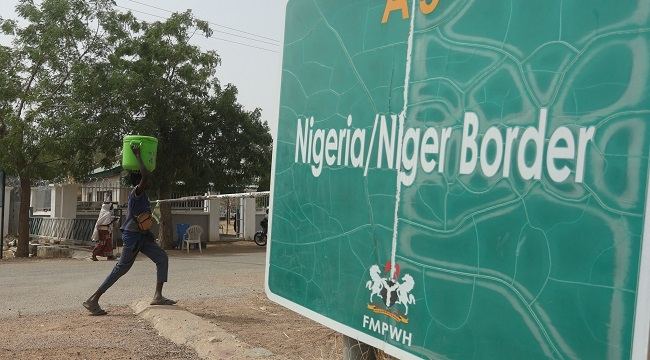
Nigeria shares over 4,000km of largely unmanned and porous borders with Niger, Chad, Benin and Cameroon — stretching from the Sahel to the Lake Chad Basin and the dense forests of the North-West and North-Central.
Security reports show:
-Over 1,400km border with Niger Republic, now outside ECOWAS standby force, is the main corridor for arms and fighters linked to ISWAP and other Sahelian jihadist groups.
-The Lake Chad axis remains active for Boko Haram and ISWAP, who move freely between Nigeria, Chad, Niger and Cameroon.
-In the North-West, banditry and mass kidnapping have worsened, with an estimated 20,000+ people killed and thousands abducted in the last four years, according to SBM Intelligence and ACLED.
-Small arms proliferation has reached an all-time high, with the UN estimating over 6 million illegal weapons in circulation in Nigeria. Musa said this complex threat is why Nigerians need to understand the sacrifices of the military.
Military Training
To bridge the civil-military gap, Musa proposed compulsory military training for every Nigerian.
“Every Nigerian should be able to go through military training. It will give you a different perspective about life. You will now understand what it means to stay hungry and what it means to work in days without sleep,” he said.
“It will show you what endurance means when you walk kilometres and you are tired but you still need to keep on going. You have not eaten… because you are doing it to protect,” he added.
He said soldiers make sacrifices comparable to giving one’s life for others, yet face insults from citizens.“Everybody wants peace, and that is important, so we want them to understand soldiers are fathers, brothers and sisters of people. They’ve families they’ve left behind, staying in the weather, rain, dust, night or day, staying there to ensure the country is secured,” Musa said.
“And that’s exactly what the military men are doing, putting their lives at stake for their country… it’s very painful when you see people insulting the military.”
Breakdown of Nigeria’s International Border States
Nigeria has 4,047 km total land border — Benin 773 km, Niger 1,497 km, Chad 87 km, Cameroon 1,690 km with 853 km coastline on the Atlantic (Gulf of Guinea).
Official records show that 16 states have direct land borders, but when maritime boundary states are added, it rises to 21 states.
The core 16 are:
WEST — Benin Republic border (773km):Lagos, Ogun, Oyo, Kwara, Niger, Kebbi — This is the busiest smuggling and irregular migration corridor. Lagos/Ogun alone account for over 250km.
NORTH — Niger Republic border (1,497km) with largest infiltration in Sokoto, Kebbi, Zamfara, Katsina, Jigawa, Yobe, Borno.
Sokoto-Katsina-Zamfara axis is now the epicentre of banditry and arms proliferation. Katsina shares 250km, Jigawa 300km.
NORTHEAST — Chad border (87km): Borno State only has the smallest border (87km) at Lake Chad, but most volatile — ISWAP/Boko Haram move between Chad-Niger-Cameroon-Nigeria.
EAST/SOUTHEAST — Cameroon border (1,690km) — longest and most porous: Borno, Adamawa, Taraba, Cross River, Akwa Ibom — Adamawa (400km) and Taraba (350km) are mountainous, ungoverned forests.
Borno is the only state that borders 3 countries: Niger, Chad and Cameroon. If maritime is included (Gulf of Guinea – 853km), yit would be 18+ states
In addition, Ondo, Delta, Bayelsa, Rivers — all have direct Atlantic frontage and are vulnerable to maritime piracy, crude theft, and arms coming by sea.
With them, the list becomes 20 states.
Therefore, both land and maritime are 20 States comprising Lagos, Ogun, Oyo, Kwara, Niger, Kebbi, Sokoto, Zamfara, Katsina, Jigawa, Yobe, Borno, Adamawa, Taraba, Benue (small tip bordering Cameroon), Cross River, Akwa Ibom, Ondo, Delta, Bayelsa, Rivers.
Nigeria’s Landmass
Nigeria has a landmass of 923,768 sq km with border states of which the largest is Borno (70,898 sq km followed by Niger State (76,363 sq km), Taraba (54,473 sq km), Adamawa (36,917 sq km), Yobe (45,502 sq km), Sokoto (25,973 sq km), Katsina (24,192 sq km).
About Author