Likely Below Average Implementation Of 2026 Capital Budget Frightens Investors
OpenLife News reports that there are strong indications that the Federal Government’s capital budget for 2026 may record zero implementation at the end of the fiscal year, forcing further extensions across multiple fiscal years – a development already frightening investors and contractors.
Speaking to Financial OpenLife in Lagos last weekend, a senior official in the Budget Office of the Federation (BOF) said, “it will be rolled over, it is normal.”
OpenLife findings from several ministries, departments and agencies (MDAs) show that the Federal Government is still stuck with 2024 and 2025 capital budget releases which are way below 50 percent, indicating that the combined budgets of the two previous years would be rolled over again to the end of this year.
The roll-over of the two previous years’ capital budgets has been done twice so far with the second roll-over set to expire by September 30, 2026.
The Executive had made the Legislature approve a roll-over of about N16.8 trillion capital expenditure appropriated in the 2024 and 2025 budget into 2026 budget up till June 2026, a date that expired without significant execution, forcing a further extension to September 30, 2026.
The N16.8 trillion formed the larger part of the N32.3 trillion capital budget for 2026.
OpenLife learnt that the balance of N15.5 trillion meant for 2026 capital expenditure cannot be implemented due to the huge outstanding for 2024/2025 capital budget.
Issues at the House of Reps
OpenLife findings also show that in the past one year, proceedings of the House of Representatives Committee on Appropriations have underscored near-zero implementation.
Presenting the committee’s findings on the floor of the House, Chairman Abubakar Kabir Bichi disclosed that N16.765 trillion had to be stripped out of the capital allocation and rolled over into the 2026 fiscal year “due to funding constraints,” after his committee met directly with the then Minister of Finance and Coordinating Minister of the Economy, Mr Wale Edun; Minister of Budget and Economic Planning, Atiku Bagudu; and DG Budget Office, Tanimu Yakubu.
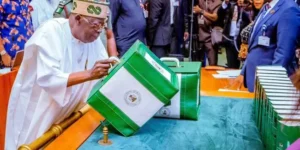
By April 2026, as the House and Senate finalised the N68.323 trillion 2026 budget, Bichi’s committee confirmed that N32 trillion was earmarked for capital expenditure and that a chunk of the increase from the executive’s original N58.47 trillion proposal existed specifically to “regularise” outstanding capital obligations carried over from 2025, so that “contractors and developers are paid for completed works.”
In effect, the Appropriations Committee’s own numbers show the 2026 budget was built, in part, on paying for the previous year’s unfinished business.
In June 2026, Majority Leader Julius Ihonvbere told the House that “substantial funds released to MDAs remained unspent due to administrative bottlenecks, procurement delays and implementation challenges,” as he moved the bill extending the 2025 capital budget’s lifespan from June 30 to September 30, 2026. Speaker Tajudeen Abbas backed it, saying “from the records we received… it has yet to be fully implemented.”
Healthcare Services Committee Exposes 0.02% Release
If one moment crystallised the shortfall, it came before the House Committee on Healthcare Services, chaired by Hon. Amos Gwamna Magaji, during the 2026 budget defence in February 2026.
Coordinating Minister of Health, Prof. Muhammad Ali Pate, told the committee that out of N218 billion appropriated for capital projects in 2025, only N36 million – about 0.02 per cent – had been released, and even that had not been utilised.Pate blamed the “Bottom-Up Cash Plan” policy operated by the Office of the Accountant-General of the Federation and delays in counterpart contributions that locked the ministry out of donor co-financing.
He described 2025 as “an unusual budget year.”
Public Accounts Committee Moves To Sanction MDAs
Where Appropriations and Healthcare committees documented the shortfall, the Public Accounts Committee, chaired by Hon. Bamidele Salam, moved toward punishment.
In February 2026, it recommended excluding 22 MDAs from the 2026 budget process – including NiMet, Federal Housing Authority, SON, NAICOM and NABTEB – over failure to account for public funds and respond to Auditor-General’s queries for 2020-2022.
Ministries In Massive Shortfalls, Investors Worried
Sector-by-sector disclosures during the 2026 budget defence showed a pattern frightening to investors and contractors: Women Affairs received N394.8m of N89.8bn (0.44%); Marine and Blue Economy got N202m of N353bn (1%); Transportation N2.5bn of N256.7bn (1%); Housing N2bn of N100bn (2%); Water Resources N1bn of N80bn (1.5%); Agriculture N3bn of N120bn.
Only N9.13bn of N1.218 trillion appropriated, or 1.3%, had been released across eight ministries reviewed.
It would be recalled that President Bola Tinubu told NASS that as at Q3 2025, only N3.10 trillion – about 17.7% – of the 2025 capital budget had been released, with priority given to outstanding 2024 projects, of which N2.23 trillion had been released as of June 2025.
Minister of State for Finance, Doris Uzoka-Anite, told Senate Appropriations Committee in February that payments for 2024 obligations were only just beginning and MDAs must upload cash plans – effectively conceding the release mechanism itself is the bottleneck.
For investors, contractors and developers, the message is clear: appropriation is no longer a reliable predictor of actual releases, and until the cash-release framework changes, each new budget arrives with the last one’s unfinished projects attached.
About Author