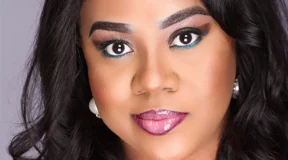
The Most Misunderstood Thing About Me
OpenLife Nigeria reports that Victoria Inyama, a veteran Nigerian actress and mental health advocate based in the United Kingdom, has unveiled the misunderstood thing about her.
The Nollywood star who began her Nollywood career in 1990 after being discovered by actor Alex Usifo, became a prominent star in the industry during the 1990s and early 2000s.
After marrying Godwin Okri and moved to the UK, she took an extended hiatus from acting to focus on her family.
After her marriage to Godwin Okri with whom she has three children collapsed, she has publicly spoken about the domestic violence and humiliation she endured during the marriage before they divorced.

Recounting the most humiliating moments in her life with Godwin Okri, her ex-husband, before they finally settled for a divorce in a live Instagram chat with Malin Anderson, a UK based mental health advocate, the veteran movie star narrated how the union started to hit the rocks after her former husband began to maltreat and humiliate her.
She also disclosed that he threatened to kill her if she failed to do his bidding, a development which made her live in fear.
“I was scared because he would tell me ‘I know a lot of people in prison, my clients that owe me a lot of favour because they didn’t do long term and I’ll just waste you and nothing is going to happen.’ At that point I just told him that I’m ready to die, I’m not coming back to you, he said alright, we will see about that,” she said.
Inyama explained that in spite of the inhuman treatment she was subjected to, her former husband insisted she cannot divorce him because she was his property.
“He would bring his girlfriends to my house to drop off the kids and one day I said can we just go for a divorce and he said you can’t divorce me, I own you, you are my property, divorce me? I said you’ve moved on, you are living with another woman in your house, he said ‘so? you are not in my house anymore, there has to be a woman in my house’ and I requested a divorce,” she said.
”He went on to say ‘first of all you cant divorce me and second of all, which man is going to want a woman with three kids? Oh, you think its because you’ve gone to the university that you think you are now intelligent? You are not intelligent.”
She also revealed how the police would later arrest her while making efforts to safeguard herself and their three kids from Okiri.
“I was arrested in front of my kids and locked up for 12 hours. That was my most humiliating moment in life,” she added.
In this chat, earlier published in Punch newspaper, the intelligent actress reveals more
What do you remember most fondly about the era of filmmaking when you were active on the movie scene?
I remember the authenticity. We were very real, down-to-earth, humble, and hungry to showcase our talents. There was no competition, no obsession with views or popularity. We just wanted to act, even when many of us didn’t fully understand what the industry entailed. We got into it with passion and truly enjoyed it. That sincerity is what I remember the most.
Many fans would love to see you on the screen again. Are you open to a comeback, or has your passion shifted completely to other things?
My passion has shifted, but if the right opportunity comes along, I would gladly step in front of the camera again. Right now, though, my focus is on psychology, wellness, and mental health; supporting people on their journeys of healing and well-being. That’s what truly drives me now.
What’s one role you played that still lives rent-free in your mind today?
I loved all my roles. Each of them was impactful in its own way. I don’t take on roles just for entertainment; they have to mean something. If I had to pick one, it would be ‘Love From Above’. It touched on domestic violence at a time when I didn’t even fully understand what domestic violence was. Life later gave that role a deeper meaning for me.
You’ve become a vocal mental health advocate and are training in therapy. What inspired you to go down that path?
I have always cared deeply about people and been curious about why we behave the way we do. Psychology gave me the tools to study and understand human behaviour. Growing up in Nigeria and later moving abroad exposed me to very different cultures, and I wanted to know: what truly shapes us?
How do our experiences and beliefs influence our identity?
Spirituality has always been central to my life, but I also wanted to go deeper. That curiosity led me to psychology. For me, it’s not only about mental health, but about wholeness and well-being.
You’ve been living in the United Kingdom for a while. What do you miss the most about Nigeria?
I mostly miss my friends. Apart from that, not much. Nigeria feels chaotic compared to where I live now—in a quiet village in Kent. I have become accustomed to the calm here, so while I miss the people, I don’t necessarily miss the environment.
What have you learnt about identity as you navigate life abroad?
My experience has been different from many others. When I came to the UK, I stayed with my dad, who worked in the House of Commons, so I didn’t struggle with integration the way some people did. I focused on academia, which made things easier for me. That said, navigating identity abroad is complex, and sometimes there are things I prefer not to say openly for professional reasons.
How do you keep your Nigerian roots alive in your everyday life and parenting?
I speak Igbo to my children, teach them about their culture, and stay active in our family and village meetings. I am proud of my heritage. I come from a beautiful royal family, and I instil that pride in my kids. Roots give you confidence and identity. That’s why I make sure my children know who they are and where they come from.

If you could go back in time and give young Victoria one piece of advice, what would it be?
Don’t be too kind. Kindness is beautiful, but people often take advantage of it and mistake it for weakness. When you eventually push back, you’re painted as the bad person. I still remind myself to set boundaries and not be overly accommodating.
In a world full of filters, how do you stay true to yourself on social media?
By being content. I don’t fake it. I don’t believe in “fake it till you make it”; that’s too stressful. I’m not a fashionista; I’m more focused on academics and personal growth. Education and training will take you far, not pretence.
Even my children know this. My eldest son is entrepreneurial, but I insist he gets at least a degree and a Master’s, because education gives you the foundation to manage your future. On social media, I post and move on. My work is sensitive, so I don’t get into unnecessary exchanges.
What’s your secret to staying fresh and young?
I mind my business. In the past, I tried to correct people on social media, but I learnt it wasn’t worth the backlash. Peace of mind and letting go of unnecessary stress keep me looking and feeling young.
You’ve spoken candidly about surviving abuse. How did your personal experience shape your counselling and healing?
Psychology has been instrumental in my healing. It gave me knowledge and tools to understand what I went through. My spirituality also helped, through forgiveness, gratitude, and letting go. That’s how I’ve been able to move forward.
You once said domestic violence is a norm in Nigeria. Can you elaborate?
Unfortunately, many people in Nigeria don’t recognise domestic violence for what it is. They see it as normal. I have been attacked online for speaking out because the assumption is always that the man is the abuser, when women can be perpetrators too.
Over time, I realised that society often brushes it aside. If the abuser is wealthy or influential, people excuse it. It used to hurt me deeply, but now I see how normalised it is. The mentality really needs to change.
How did you find the strength to leave your toxic marriage?
I didn’t leave; I was removed by the police. That’s the truth. I wouldn’t have left otherwise.
What advice do you have for women trying to reclaim their voices after years of silence and domestic violence?
Move on and live your life. Improve yourself, release the pain, and don’t let the past destroy your future. In psychology, we say, “the body keeps the score.” Stress leaves marks on the mind, heart, and even physical health. Many survivors later develop illnesses because of the toll stress takes. My advice is to let go, focus on your healing, and make the best of the life you still have.
How do you balance being a mum, psychologist and a public figure all at once?
I can’t tell you exactly how I do it; I just take it one day at a time. First of all, being a mother is everything. After God, my kids come first. Having a great relationship with them is paramount, because I don’t want them to have miserable childhood memories. I make sure I’m present for all three of them. They’re young adults now, and they need guidance and direction. We are friends, but with healthy boundaries.
With my master’s in applied psychology and coaching psychology, I also support people through therapy. My style is personal because I know what it feels like to be in certain situations. Even though everyone’s experiences differ, there’s often a sense of sadness or drowning. My duty is to help lift people up.
What is the most misunderstood thing about you?
That I’m too honest and too kind. People often misunderstand my honesty as arrogance and my kindness as weakness. It really depends on the mindset of the person I’m dealing with.

When I was in university, I loved learning and was always excited to share. But I noticed that when you make simple comments online, people lash out. For instance, a child was once filmed breaking things in a supermarket. People said, “beat the child.” I commented, “Do you know if this child is autistic or has ADHD? Maybe being in a public place triggered him.” The responses were, “beat it out of him.”
Many of the issues adults face now stem from childhood trauma. They grew up thinking violence is a form of communication. But violence is not communication. Even nations at war look for alternatives before fighting.
As a survivor of domestic violence, how do you think the entertainment industry can better support victims and raise awareness about the issue?
The industry is not authentic when it comes to speaking against social issues. Many celebrities mind their business, pretending everything is fine until things spiral out of control. A lot of them tolerate the same situations privately. They should be using their platforms to create change, but most don’t care.
And sometimes, even when you tell someone, “This marriage or situation will kill you,” they say, “What’s your business?” Some even believe that if their partner doesn’t beat them, it means there’s no love. How do you help someone who doesn’t even believe they need help? That’s why I feel the industry can only do so much.
You’ve spoken about the importance of self-love and self-care. Can you share some practices that have helped you heal and maintain your well-being?
Going back to school was a big part of my healing. I love reading, researching, and learning. Psychology is my passion, and what I learn helps me as much as it helps others.
I also watch movies and TV, listen to music, and join prayer sessions. Sometimes I just lie down, meditate, and say affirmations. I used to go to the gym and I’m planning to start again. I also attend movie premieres and events; they’re relaxing for me.
Most importantly, I treat myself with love. I honour my body and spirit. I’m careful about what I eat, what I consume mentally, and the words I speak to myself. My biggest practice is showing myself love and respect.
How do you relax and ease stress?
I love to sleep. Sleep is one of my best ways to relax. I also enjoy good movies, meditation, and rest. I’m not really a phone person; I’m still getting the hang of Instagram and TikTok.
In the evenings, I spend time supporting people by checking on them and sometimes giving advice. If I’m not doing that, I’m lying in bed, enjoying my me-time.
About Author